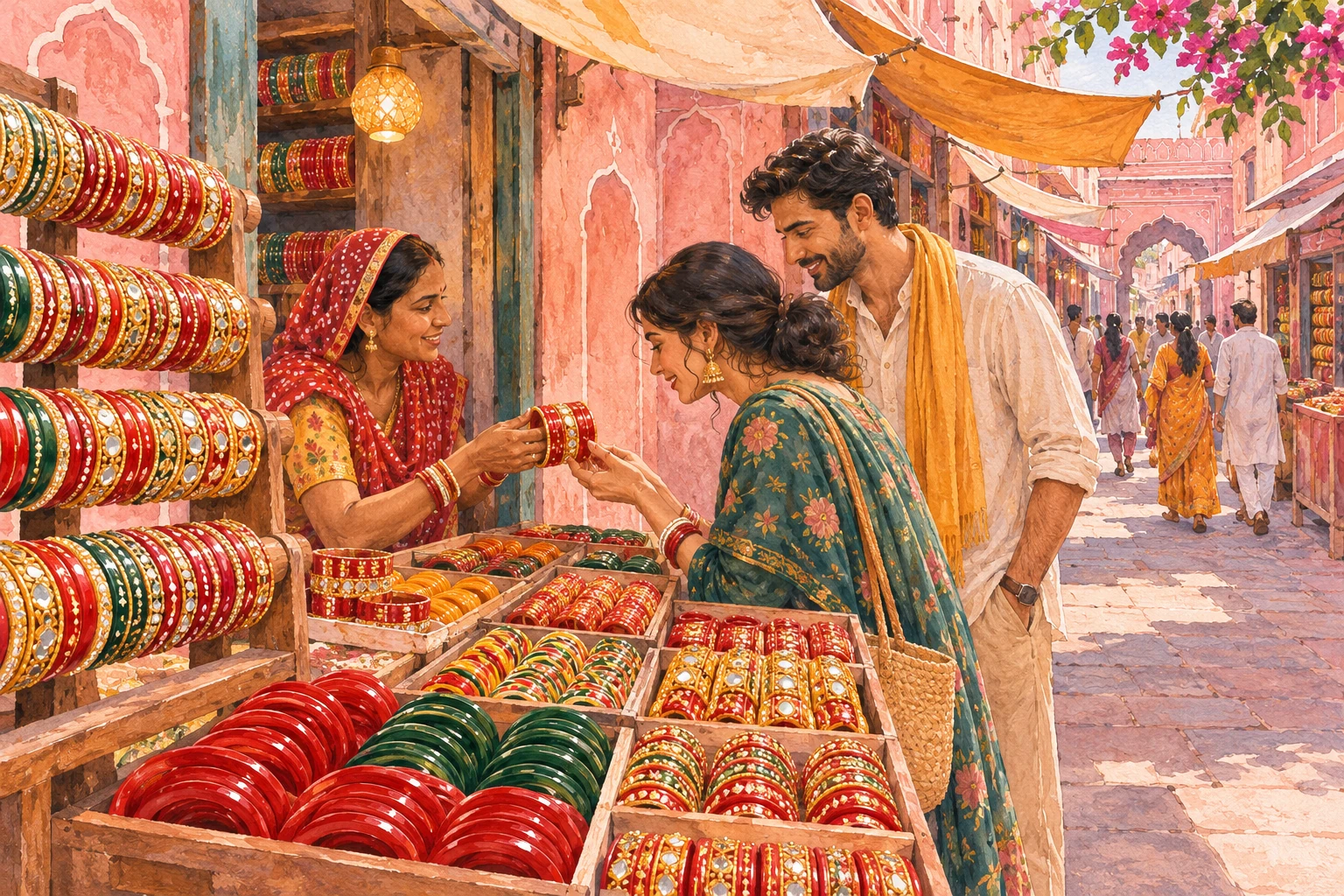

Cover image: digitally generated illustration inspired by Jaipur’s bangle markets. The people and setting are artistic interpretations.
Choosing bangles in Jaipur can take longer than you expect. There is the colour to settle on, then the width, the decoration and the way a set looks when it catches the light. At Maniharon ka Rasta, you can also take an interest in the work that went into making it.
This lane in the Tripolia Bazaar area is closely associated with Jaipur’s Manihar community and its lac-bangle trade. It is a lovely stop for anyone who enjoys local crafts, whether you are matching a wedding outfit or choosing a small reminder of your trip.1,2
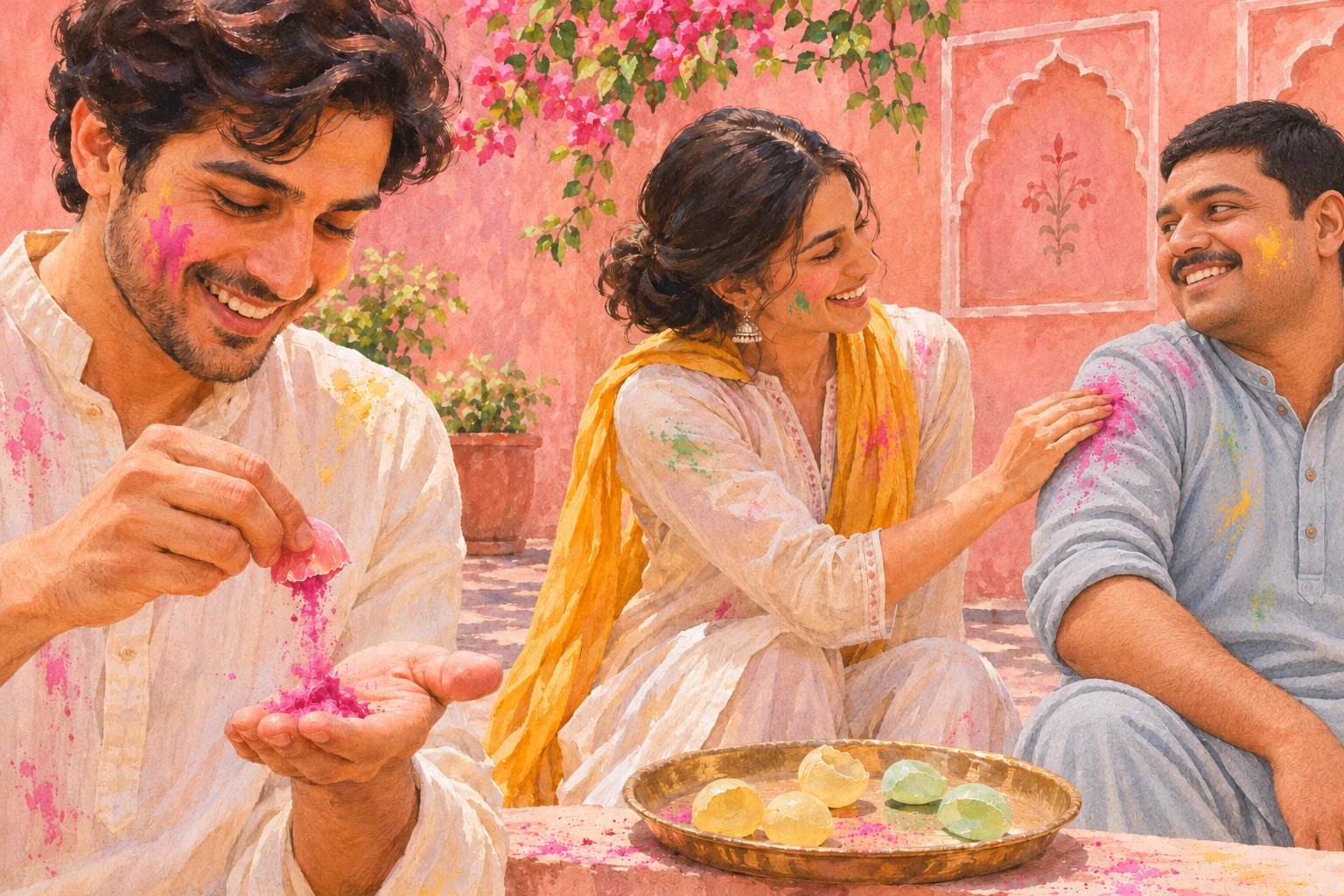
There is another reason to know the name. Before Holi, some of the same craft families make gulal gotas: fragile lac shells filled with dry colour, ready to break in a burst of pink, yellow or green.9,10
A few things to know before you go
| Planning your visit | A useful starting point |
|---|---|
| Location | Maniharon ka Rasta, in Jaipur’s old city around Tripolia Bazaar. It is also written as Maniharo ka Rasta or Maniharon ka Raasta. |
| Allow | Around 90 minutes to two hours for browsing and choosing a set, plus your journey. |
| Best season for a walk | October to March is generally more comfortable. |
| If you want to watch the craft | Contact a shop first if a demonstration is the main reason for your visit. |
| If you want gulal gotas | Ask about availability before Holi; the work is seasonal. |
Individual shops keep their own hours, so check your chosen stop before setting out. The visit length above is a suggestion for an unhurried browse; give yourself longer if you are ordering several sets.
A craft woven into the old city
Many of Jaipur’s old streets still tell you something about the trades that grew around them. The city was founded in 1727 by Sawai Jai Singh II, and its commercial life was part of the plan. UNESCO’s account of Jaipur describes craft streets and markets, including those associated with lac jewellery.4
Maniharon ka Rasta belongs to that story. Generations of Manihar makers have worked with lac, creating bangles worn at weddings, festivals and family occasions. The Indian Institute of Crafts and Design’s profile of artist Avaz Mohammed also describes the community’s connection with gulal gota making.1
There is a shared cultural history here too. Many of the makers are Muslim, while their bangles and gulal gotas have long been part of Hindu wedding and Holi traditions. For a visitor, a conversation about one small object can open up a much bigger picture of Jaipur.1
What are lac bangles made from?
Lac — sometimes written as lakh or laakh — is a natural resin produced by tiny insects living on host trees. It is collected and processed; one refined form is called shellac.5
The material becomes workable when warmed. That is what lets an artisan roll it, curve it and shape it into a bangle. Colours and decorations give the finished pieces their variety, from simple glossy rings to more elaborate sets.1,6
The pleasure of watching a bangle take shape
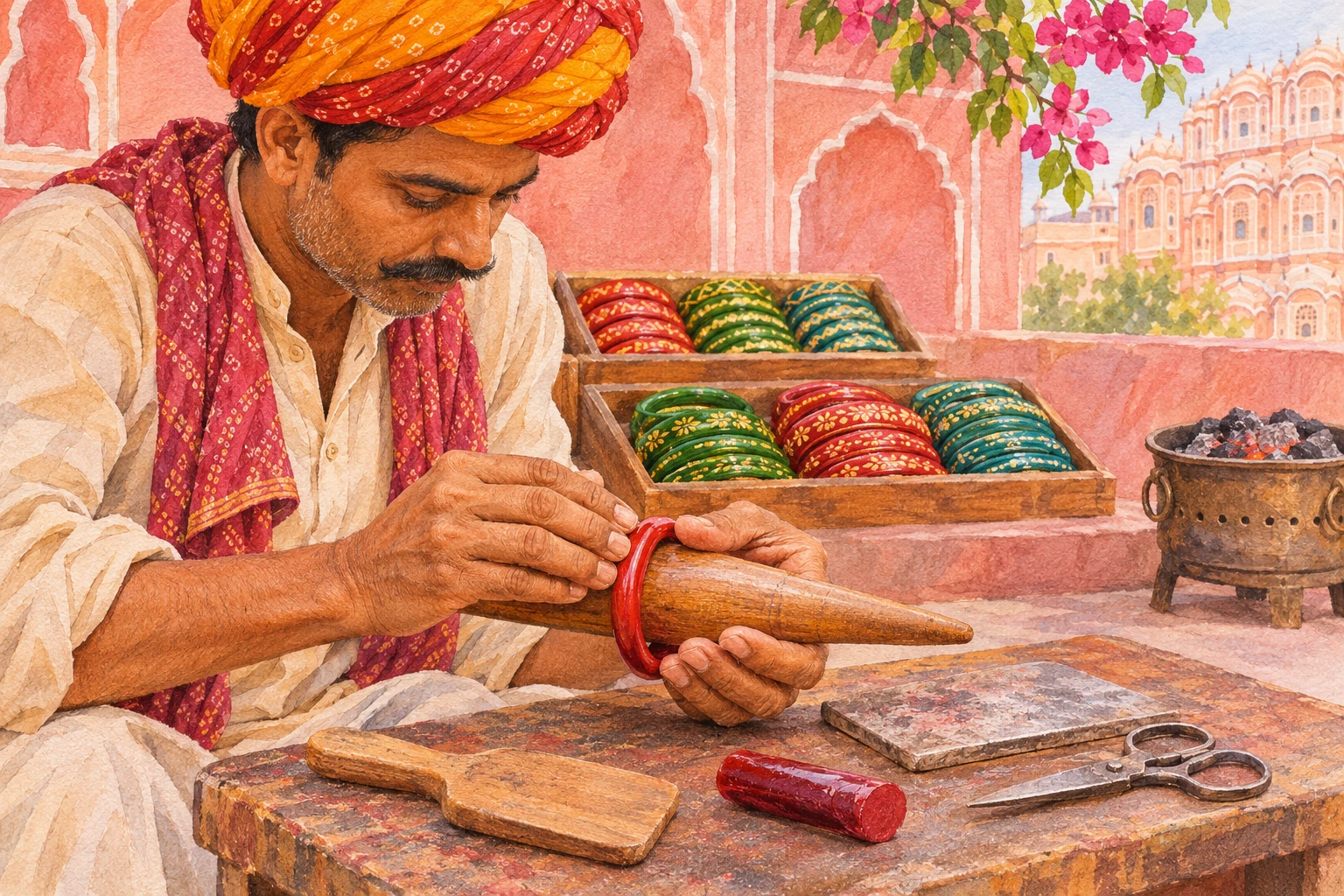
If you have the chance to watch a maker at work, look at the hands. The tools may be simple, but getting an even thickness, a neat join and the right fit takes practice.
Prepared lac is warmed and worked with colour, then rolled into a length. The maker cuts and curves it, joins the ends and shapes the ring on a wooden mandrel. Depending on the design, the bangle may then be decorated or given a different surface finish.6,8
That final sizing is particularly interesting to watch: the ring has to become round and fit the person who will wear it. At a shop counter you may see this stage or a finishing detail, even when the earlier preparation happens elsewhere. Ask whether you can watch, and give the maker room to work.
Come along with Ranavilas Travel Diaries
Our Travel Diaries team visited Maniharon ka Rasta to watch bangles being made and pick out a few favourites. The short reel below gives you a glimpse of the outing before you plan your own.
Open this reel on Facebook if the embedded player does not load.
From a bangle to a burst of Holi colour
A bangle is made to keep its shape. A gulal gota is made to break. Both begin with lac, but the skill takes them in very different directions.
A gulal gota is a small, hollow shell filled with dry gulal — the coloured powder used at Holi. When its delicate casing breaks, the colour is released. Jaipur’s tradition of using these shells is associated with royal Holi celebrations as well as the craft families who have kept making them.9,10
To make the hollow form, an artisan warms the prepared lac and blows air into it through a slender pipe, often called a phunkni. The shell is then filled with dry colour and its opening is closed. Producing something so thin, yet strong enough to fill and pack, is part of the challenge.9,10
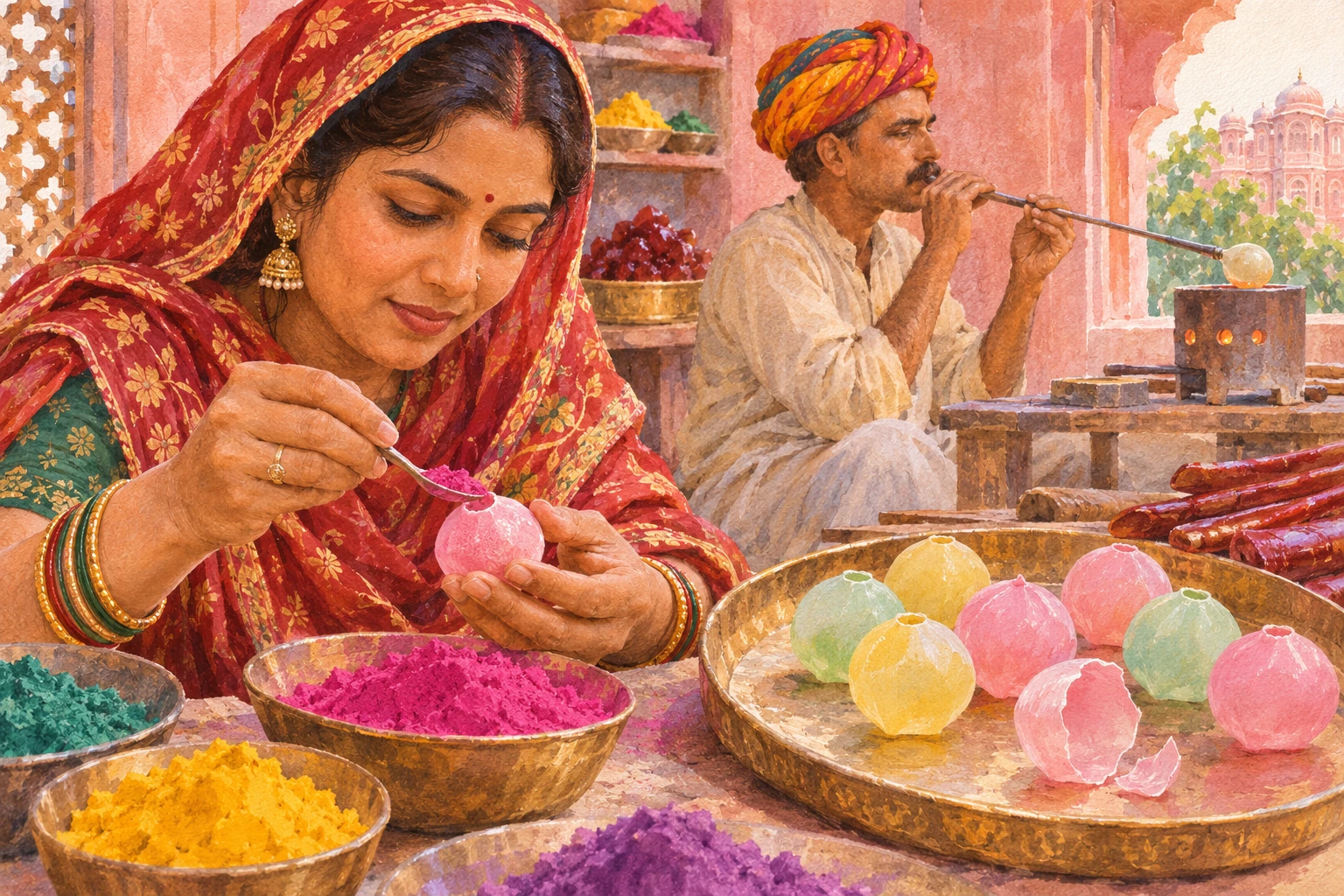
The work becomes especially relevant in the run-up to Holi. Bangles provide a more regular trade, while gulal gotas bring a seasonal change to what craft families are making. If you want to see them being prepared, ask ahead rather than expecting them on every visit.9
Traditional play includes tossing the fragile shells so that they break and scatter powder. If you buy some for a celebration, ask about the colour inside and the best way to handle them. Play only with willing participants, keep powder away from eyes and avoid throwing at faces or breathing in the dust. A “natural” or “herbal” label alone does not tell you everything about a product’s ingredients.
Choosing a set to take home
Start with the fit. A closed bangle needs to pass over your hand, so measuring only the wrist can be misleading. For a gift, bring a bangle that already fits the person, or note its inner diameter.
An outfit photograph taken in daylight is useful when matching colours. Once you have found a set you like, try it on with the seller’s help and check that the inner edge feels comfortable.
- Look at the pieces being packed. Check the join and any loose or catching decoration, rather than relying on a display sample.
- Ask what you are buying. The material, core and decoration can vary. A shop’s location or the look of a piece cannot tell you its complete making history.6,7
- Confirm the complete set. Make sure you agree on the sizes, number of bangles and whether the price is for one, a pair or the whole selection.
- Ask for proper packing. A cushioned, rigid box is useful for the journey. Follow the maker’s care advice and keep the bangles away from crushing pressure or a hot parked car.
Gulal gotas need their own packing conversation. Their shells are meant to be fragile, so tell the seller how far you are travelling and ask what is practical to carry.
Make a relaxed old-city outing of it
For a first visit, give the lane about 90 minutes to two hours. Browse a little before choosing, leave time to ask about the work and allow a few extra minutes for sizing and packing. You do not need to fill the afternoon with a long shopping list.
October to March is generally a comfortable season for walking in Jaipur. Late morning or afternoon can suit a shop visit once opening hours are confirmed. In hotter weather, choose the cooler part of the day and keep the walk shorter.3
If you want to add sightseeing, choose one nearby old-city interest, such as City Palace or Jantar Mantar, and allow for its own opening hours and visit time. Our Jaipur shopping guide can help you choose another market if you have a different craft in mind.
This is a working lane, so a little consideration goes a long way. Ask before filming people or entering a work area, keep shop entrances clear and stay back from heaters and hot material. A longer demonstration or interview is best arranged in advance. Where bargaining is welcome, keep it friendly and compare similar pieces.
Visiting from Ranavilas
If you are staying at Hotel Ranavilas Palace in Sitapura, plan Maniharon ka Rasta as part of an old-city outing. Allow extra time for the drive, check the route before setting off and agree on an easy meeting point for the return journey. You can speak to reception about your plans and the arrangements you need.
For another craft-focused day, our guide to Bagru and its block-printing traditions follows a different set of skilled hands. Together, the two visits offer a rewarding way to get to know the things you might otherwise only see on a shop shelf.
A few questions visitors ask
Is Maniharon ka Rasta the same as Tripolia Bazaar?
It is a particular lane in the wider Tripolia Bazaar area. Ask for it by name and use the shop’s own location pin if you have arranged a visit.
Can I have bangles made or adjusted to my size?
Ask the seller what can be done for the design you choose and how long it will take. Sizing or custom work depends on the piece and the shop’s arrangements.
Will I find gulal gotas outside Holi season?
Availability is seasonal. Contact a maker first if gulal gotas are the main reason for your trip.
Sources and further reading
The Five Colors of Travel article below inspired this guide. We also used craft documentation, institutional sources and reporting to check the background. The illustrations are digitally generated; the Travel Diaries reel is Ranavilas footage.
- Indian Institute of Crafts and Design — Shri Avaz Mohammed, National Awardee for Lac Work (2019)
- Nagar Nigam Jaipur — Main Markets in Jaipur, Tripolia Bazaar section
- Rajasthan Tourism Development Corporation — Best Time to Visit
- UNESCO World Heritage Centre — Jaipur City, Rajasthan
- Food and Agriculture Organization — Non-wood forest products, Insect products, Lac
- D’source / NID — Lac Bangles, Jaipur: Making Process
- Gaatha — Maniharon ka Raasta (2012)
- D’source / NID — Lac Bangles, Jaipur: Tools and Raw Materials
- The Indian Express — On Holi, a look at Jaipur’s traditional celebrations with Gulaal Gota (22 March 2024)
- Craft Revival Trust, Asia InCH — Lac Balls / Gulal Gota of Jaipur, Rajasthan
- Five Colors of Travel — Lac Ki Choodiyan, Maniharon ka Rasta (1 January 2026)


One Response