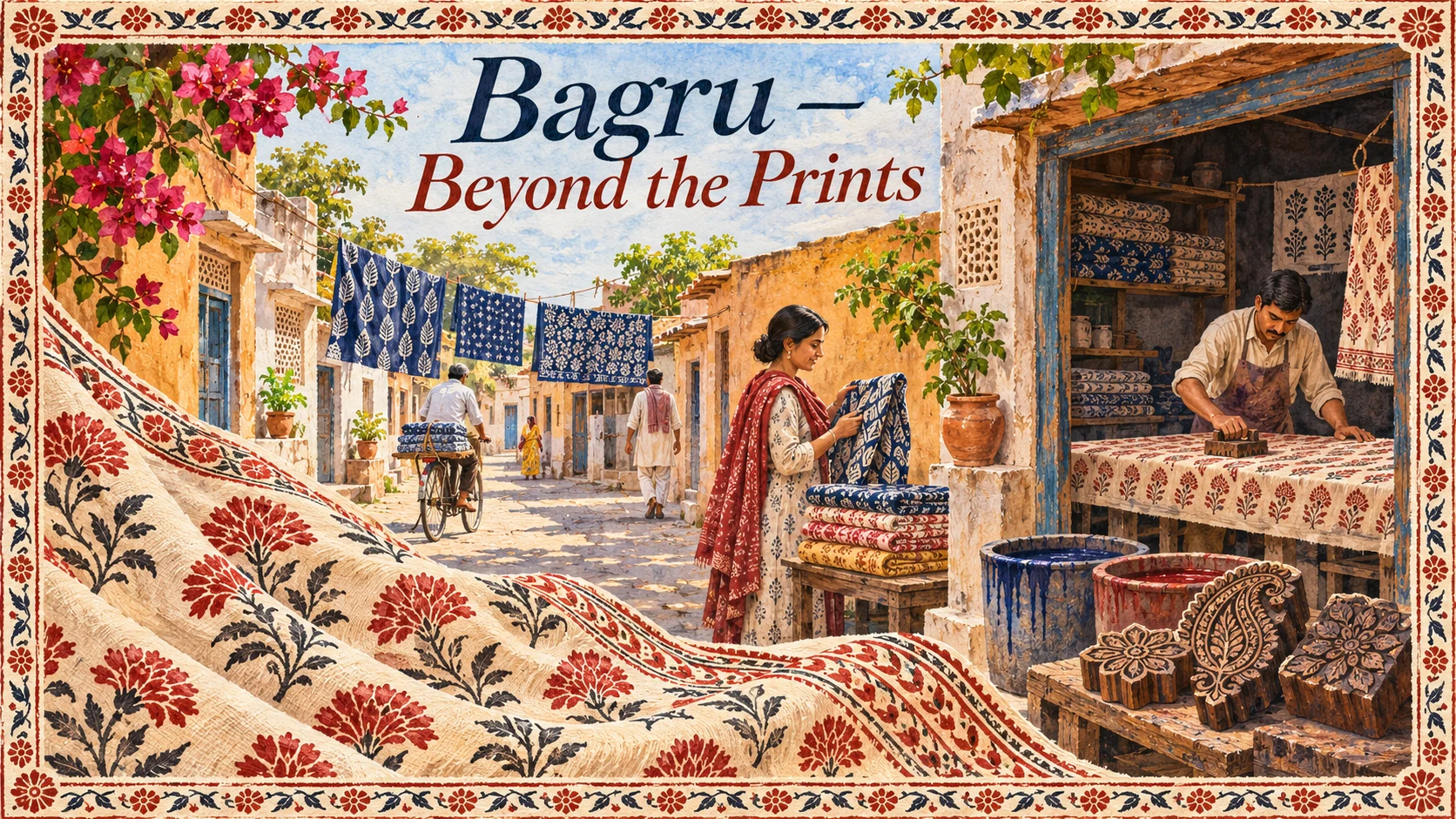

A length of printed cotton is a lovely thing to bring home from Jaipur. In Bagru, it can also lead you into a much bigger story: families of printers, neighbourhood temples, journeys to market and the patient work behind a repeating flower.
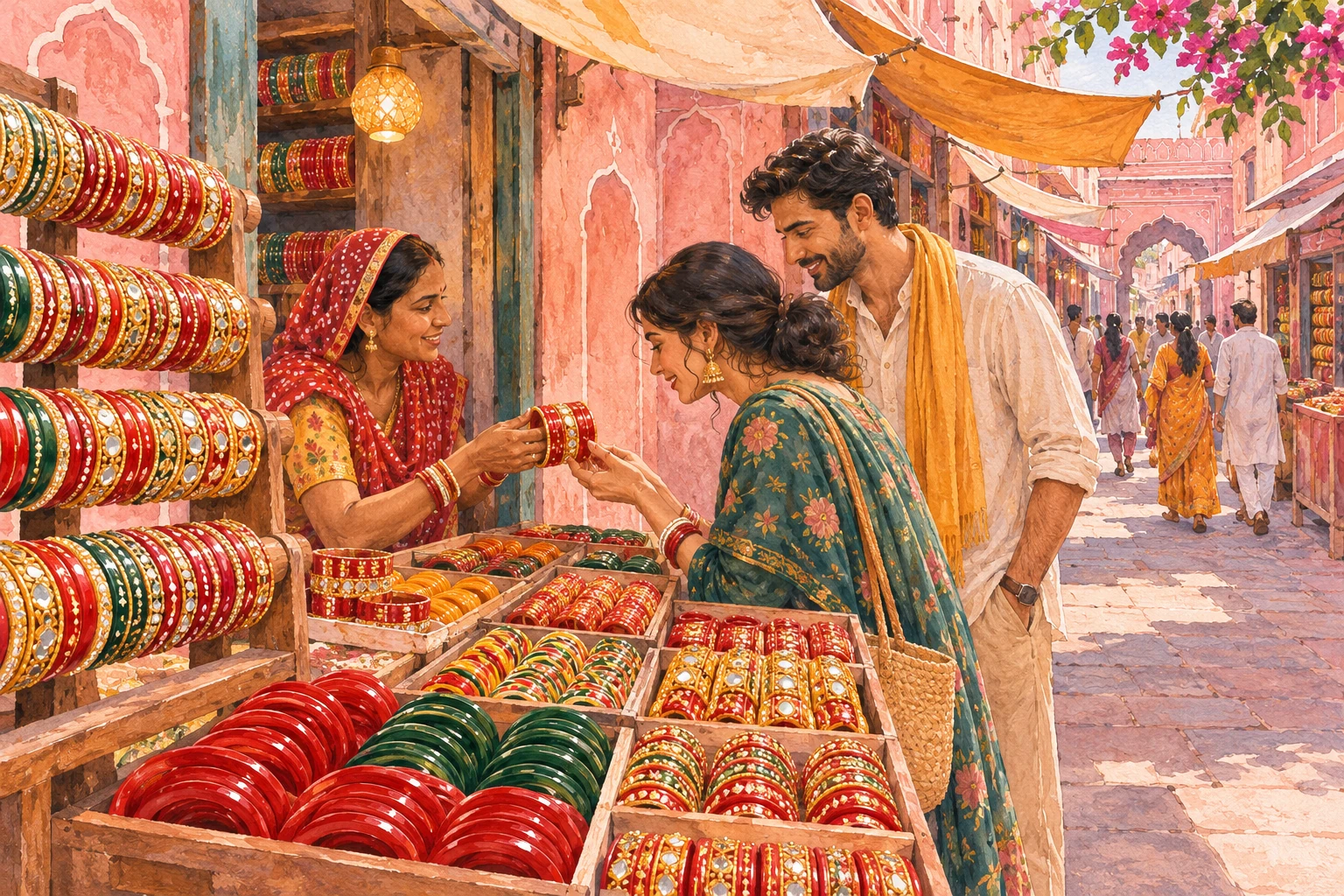
Cover image: digitally generated illustration inspired by Bagru’s textile traditions and town life. The scene is an artistic interpretation, rather than a record of a particular street.
Bagru lies southwest of Jaipur, along the Jaipur–Ajmer road. Its name travels far on scarves, shirts and furnishing fabrics. A visit brings that familiar label back to the people and places behind it.
A museum stop, a prearranged workshop and a walk through the old town make a rewarding combination.
A quick guide to visiting Bagru
| Planning point | What to know |
|---|---|
| Location | Roughly 30–35 km from central Jaipur, depending on your starting point and destination.[1] |
| From Sitapura | Use approximately 40–45 km each way only as an initial planning range from the Sitapura Industrial Area. A published third-party Bagru–Sitapura estimate is 41 km; confirm the actual hotel-to-workshop route.[2] |
| Time to set aside | The suggested activities total 3½–5 hours in Bagru. Adding an estimated 60–90 minutes each way from Sitapura gives 5½–8 hours overall, before meals, local transfers or delays. Allow most of the day. Travel allowances are planning estimates, not live traffic predictions. |
| Who it suits | Textile lovers, curious shoppers, design students, photographers who enjoy everyday details, and families with children old enough to enjoy a supervised craft activity. |
| Best season | The cooler months, especially October to February, are comfortable for walking and workshop visits.[3] |
| First thing to arrange | A confirmed workshop or museum appointment, with the exact location pin and a return transport plan. |
A town made by many kinds of skilled hands
The Chhipa community is central to Bagru’s printing tradition. Research published in the NIFT Journal of Fashion describes a network of printers, block makers, dyers and washers whose work depends on one another. A finished textile carries the contribution of several skills.[4]
That gives you a useful way to explore. Ask who carved the block, who printed the cloth and where the dyeing happened. A single question about a flower on a scarf can become a conversation about an entire working neighbourhood.
The craft’s beginnings are often described through oral histories stretching back several centuries. Those accounts are valuable, but they do not provide one securely documented founding date for every printing family.[3] [4]
When the journey to Jaipur took all night
One particularly evocative local recollection appears in Pinkcity.com’s 2012 report on Bagru. Former sarpanch Sitaram Jhalani described printers leaving for Jaipur by bullock cart on Friday evening, waiting for Chandpole Gate to open, and selling cloth at the Saturday market near Gangauri Bazaar.[5]
It is a remembered account of an earlier trading life, rather than a description of today’s market arrangements. It also adds something to the next piece of cloth you unfold: getting it to a customer once involved an overnight journey.
Follow the market names into the old town
Bagru’s everyday geography has stories too. The same neighbourhood report records market names associated with temples: Lakshminath Bazaar, Ganga Mata Bazaar, Raghunathji’s market and Jugal Bazaar.[5]
If you enjoy this side of a place, ask a local guide to help you find the lanes around Lakshminathji and Jugal Kishorji. The report places Jugal Kishorji’s temple beside the old fort wall. Treat these as neighbourhood heritage stops; arrange any interior visit locally and respect worship, photography rules and private boundaries.
There is pleasure in simply paying attention to a doorway, an old shopfront or the name by which residents know a lane.
Start with Titanwala Museum
Titanwala Museum, also known as Titanwala Sangrahalaya, is a useful introduction to the craft. Created by the printing family of Suraj Narain Titanwala and his son Deepak, it brings together textiles, wooden blocks, tools, vessels and family material connected with Bagru’s printing history.[6]
The appeal is the connection between a displayed object and a working skill. An old block becomes more interesting when you understand how its carved surface transfers a design to cloth.
Allow roughly an hour or two if this is your main museum stop. Confirm current access and whether a demonstration or hands-on session can be arranged; these are separate questions from simply visiting the galleries.[6]
At the printing table, watch the joins
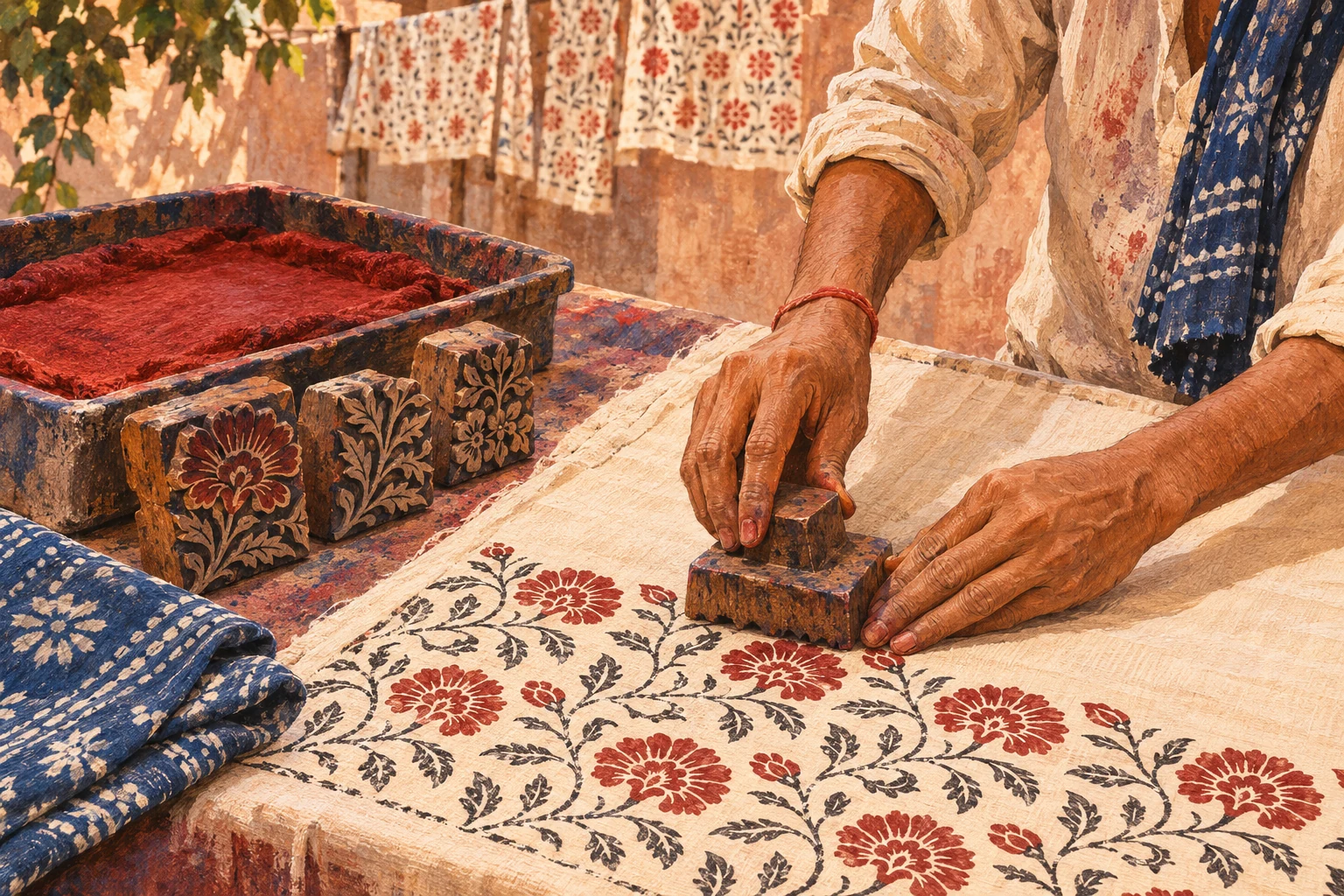
A repeating design asks the printer to place the next impression accurately beside the last. Watch where the edges meet, how the block is held and how a border keeps its direction. After a few minutes, the apparent simplicity begins to look like considerable skill.
Bagru’s traditional repertoire includes red-and-black printing on a warm, prepared ground, as well as dabu, or mud-resist work. With dabu, a paste protects selected areas during dyeing; removing it reveals the reserved pattern.[7]
For a hands-on visit, ask what you will actually do. Jai Texart, for example, describes both demonstrations of natural-dye and mud-resist processes and a visitor activity using pigment dyes. A short souvenir-printing activity can be enjoyable while covering only one part of the wider craft.[1]
Bagru and Sanganeri prints: what is the difference?
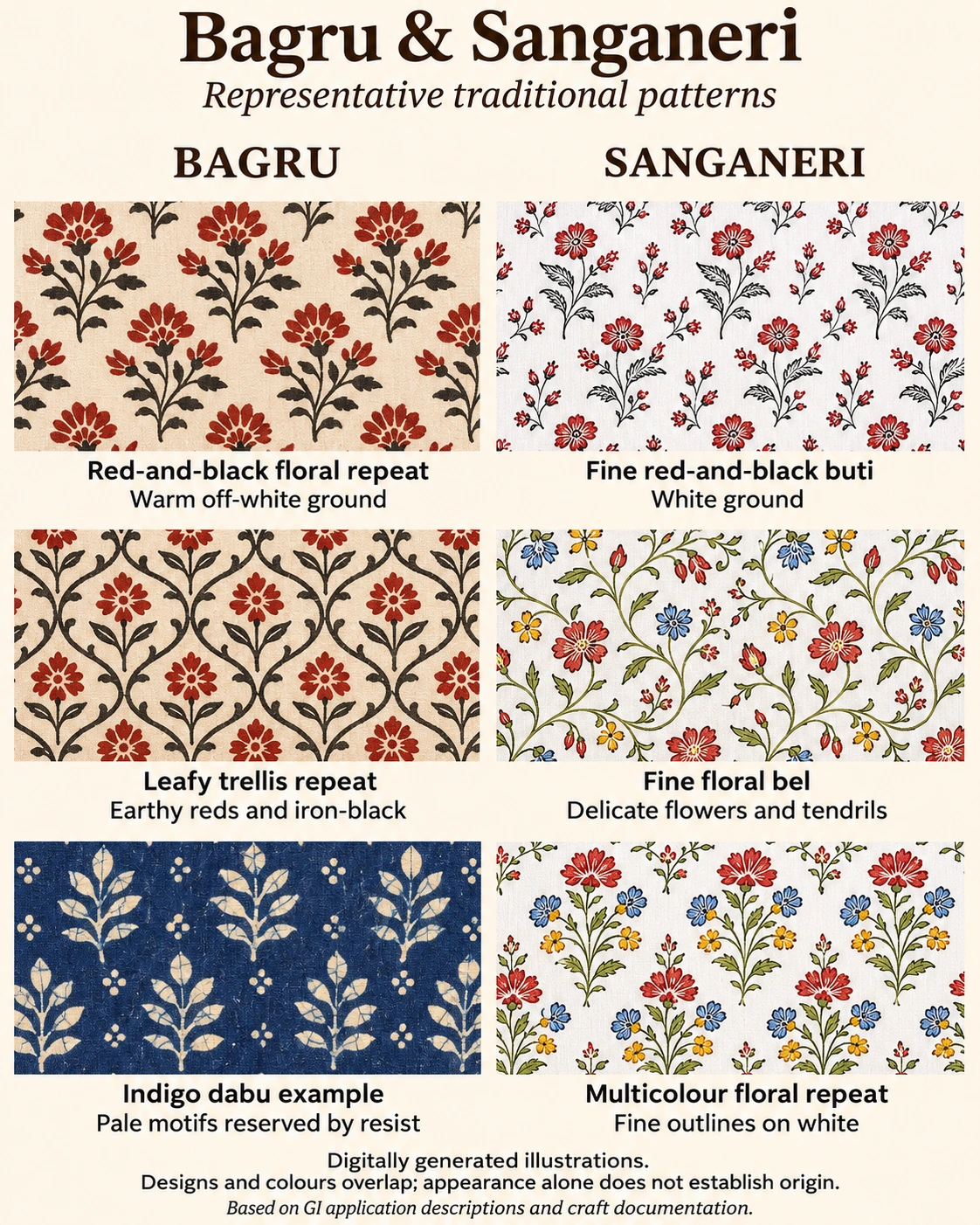
Both belong to the Jaipur region’s rich hand-block-printing traditions. The comparison below shows selected traditional combinations of ground colour, motif and printing technique.[8] [9]
A blue background, a floral motif or a small irregularity cannot by itself establish a textile’s origin or method. Ask where and how it was made. Both Bagru Hand Block Print and Sanganeri Hand Block Printing appear as registered products in India’s Geographical Indications register.[10]
| What to look at | Bagru tradition | Sanganeri tradition |
|---|---|---|
| Background | Often a warm cream or yellowish prepared ground; dyed grounds, including indigo, also feature. | Especially associated with white or off-white backgrounds. |
| Colour impression | Earthy red, iron-black, ochre and indigo are familiar associations. | Fine designs, including red-and-black and multicoloured work, stand out against a light ground. |
| Patterns | Floral, plant and geometric repeats appear across the repertoire. | Particularly celebrated for delicate flowers, small butis, larger butas and trailing floral patterns. |
| Process to ask about | Ask about red-and-black printing, dabu resist and the dyeing used for the particular piece. | Ask how the fine outlines and colour areas were printed, and how many blocks the design required. |
Buy the cloth with a few good questions
You do not need to become a textile expert before buying a scarf. A few clear questions help:
- Who made it, and where? Ask for the workshop or maker’s name.
- How was the pattern applied? Establish whether it was hand-block printed, screen printed or digitally printed.
- Which dyes or pigments were used? Hand printing and natural dyeing are separate attributes; ask about both.[3] [7]
- What is the fabric? Check fibre, usable width and whether you are buying a finished item or cloth by the metre.
- How should it be cared for? Ask about colour transfer, shrinkage and washing instructions for that piece.
Open out the textile before deciding. Look at the repeat, the edges, any stitching and the overall condition. Small variations can accompany handwork, but neither irregularity nor perfect alignment is proof of authenticity.
If buying directly from a workshop, give the maker time to explain. An agreed demonstration or lesson deserves payment for the teaching involved. Keep the bill and care instructions with your purchase.
Plan your Bagru day trip
Build the day around one confirmed appointment. The four stops below total 210–300 minutes, or 3½–5 hours in Bagru. Rearrange them around opening arrangements:
| Part of the visit | Suggested time |
|---|---|
| Titanwala Museum or a guided introduction to the craft | 60–90 minutes |
| A short walk through the old-town lanes with local guidance | 30–45 minutes |
| A prearranged demonstration or introductory printing activity | 90–120 minutes |
| Browse, ask questions and choose a textile | 30–45 minutes |
With the estimated two to three hours of return travel from Sitapura, this programme needs 5½–8 hours before meals, transfers between stops or delays. For a shorter outing, choose a museum visit or a workshop and reduce the walking and shopping stops.
Before leaving Jaipur: confirm the destination pin, opening arrangements, activity length, language of instruction and return transport. Wear comfortable shoes and clothes suitable for a working studio. Ask before photographing people, entering work areas or touching cloth laid out to dry. Drying displays depend on weather and production, so let them be a welcome part of the visit when available.
Make room for Bagru in your Jaipur stay
Bagru suits a day when you want to slow down and understand how something is made. Guests staying at Hotel Ranavilas Palace in Sitapura can plan Bagru as a separate day trip alongside their Jaipur sightseeing.
For the wider trip, our Jaipur shopping and local crafts guide helps put purchases in context, while our scenic day trips from Jaipur guide offers other ways to explore beyond the city.
A piece of Bagru cloth can come home with you. Knowing a little about the hands, lanes and journeys behind it makes it a better souvenir.
Sources and further reading
Sources checked on 22 November 2026. The older neighbourhood report is used for attributed local recollections and heritage context. Visitor arrangements should be checked directly before travelling. External links open in a new tab.
- Jai Texart — Bagru workshop and visitor-experience information.
- DistancesFrom — indicative Bagru–Sitapura Industrial Area road distance. This is a third-party planning estimate, not a verified hotel-to-workshop route.
- Gaatha craft documentation — Block Printing, Bagru.
- NIFT Journal of Fashion, Volume 1 (2022), especially the Bagru community fieldwork discussion on printed page 235 (PDF page 246).
- Pinkcity.com — “बगरू – इतिहास को सहेजता वर्तमान” (3 July 2012), the inspiration for exploring the town beyond its textiles and a source of attributed local accounts.
- Sahapedia / Museums of India — Titanwala Sangrahalaya; also listed by Anokhi Museum of Hand Printing.
- Studio Bagru — The buyer’s guide, for process terminology and questions about production.
- CBSE — Grade VIII Block Printing skill manual, including its Bagru/Sanganeri comparison.
- Incredible India — Sanganeri Hand Block Printing.
- IP India GI register: Bagru Hand Block Print, application 183 and Sanganeri Hand Block Printing, application 147.
- Producer-association GI application descriptions: Bagru Hand Block Print and Sanganeri Hand Block Printing, copies hosted by oriGIn. The comparison illustrates selected documented visual features, rather than reproducing authenticated textile specimens.


2 Responses