
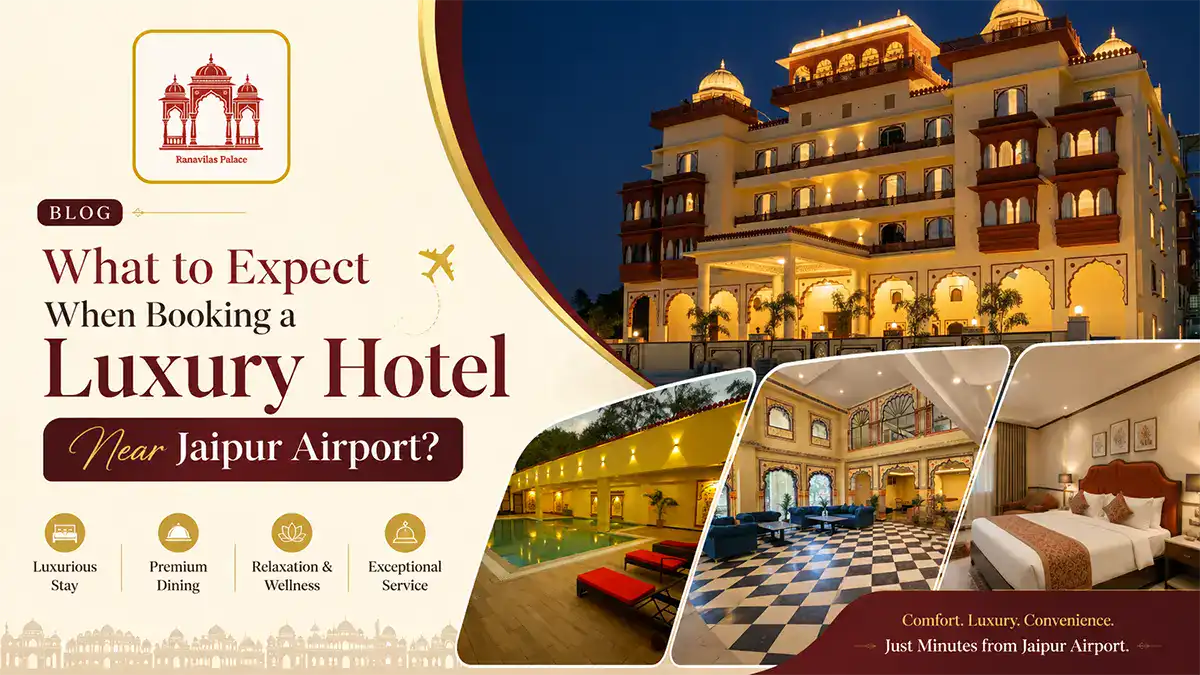

There’s a particular kind of tiredness that hits the moment you step off a flight, whether it is Jaipur International Airport or any other airport. It’s not just the flight itself – it’s the recycled cabin air, the cramped legroom, the dehydration, and then, almost on cue, the dry desert heat and dust of the Pink City wrapping around you as you walk out toward the taxi stand.
Add an hour of honking traffic on Tonk Road or Ajmer Road to reach your hotel, and what should have been the exciting start of your Jaipur trip turns into an exhausting extension of your journey.
This is travel fatigue, and it’s completely avoidable with one decision made before you even land: where you choose to stay.
What Travel Fatigue Actually Is – And Why Jaipur Makes It Worse
Travel fatigue isn’t just jet lag from crossing time zones. For most visitors flying into Jaipur – whether from Delhi, Mumbai, Bengaluru, or an international hub – it’s a mix of dehydration, disrupted sleep, muscle stiffness from sitting, and sensory overload from noise and crowds. Rajasthan’s climate compounds this.
For much of the year, Jaipur runs hot and dry, with dust carried in from the edges of the Thar Desert. Step outside the airport terminal at midday in April or May, and the heat alone can undo whatever rest you managed on the plane.
Then there’s the traffic. Jaipur’s road network funnels heavily through a handful of corridors – Tonk Road, Ajmer Road, and the routes into the old walled city – and these get genuinely congested during morning (roughly 9–11 AM) and evening (6–9 PM) peak hours. A hotel that looks close on a map can still mean 45 minutes of stop-start traffic if it sits on the wrong side of that congestion.
The First 60 Minutes Matter More Than Most Travelers Realize
This is where hotel location stops being a minor detail and becomes the single biggest factor in how quickly you recover from your flight. A hotel genuinely close to Jaipur Airport (Sanganer) – rather than one that’s merely “central” on paper – can cut your post-landing commute from nearly an hour to under 20 minutes.
| Hotel Zone in Jaipur | Approx. Distance from Airport | Typical Drive Time | What to Expect on the Road |
| Sitapura / near-airport belt | 6–12 km | 15–20 minutes | Light industrial-corridor traffic, minimal congestion |
| MI Road / Civil Lines | 13–16 km | 30–35 minutes | Moderate city traffic, worse at peak hours |
| Old City / Pink City (Hawa Mahal area) | 18–20 km | 40–45 minutes | Heavy congestion, narrow lanes, frequent jams |
| Amber & Jaigarh Fort area | 28–30 km | 55–65 minutes | Heavy tourist traffic, especially mornings |
Distances and drive times are approximate and vary with traffic conditions and exact route taken.
For a traveler running on four hours of sleep, that difference between 15 minutes and 45 minutes isn’t just convenience – it’s the difference between checking in and actually resting versus arriving even more drained than when you landed.
What to Expect When You Walk In: Heritage That Slows You Down, in a Good Way
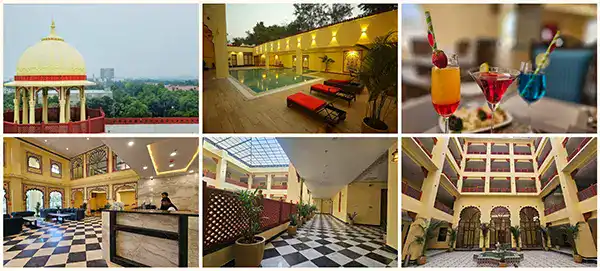
Once you’ve minimized the commute, the next thing that determines how well you recover is the environment you walk into. This is where a genuine heritage property near the airport has an advantage over a standard business hotel.
Instead of a generic glass lobby, you’re met with Rajasthani architecture – carved stone jharokhas, hand-painted walls, open courtyards, and interiors that reflect Jaipur’s royal history rather than a template chain hotel.
It sounds like a small thing, but there’s a real, documented effect where stepping into a calmer, visually grounding space helps the nervous system downshift faster than a sterile airport-hotel environment does.
At a property like this, check-in itself is designed around the fact that you’ve just traveled: a welcome drink, minimal paperwork, and a fast route to your room rather than a long wait in a busy lobby.
Quiet Rooms: Where Actual Recovery Happens
Rest after travel isn’t just about lying down – it’s about uninterrupted sleep, and that depends heavily on how well a hotel controls sound. Rooms that are properly insulated against outside noise (traffic, nearby events, other guests) make a measurable difference to how rested you feel after even a two-hour nap.
Look for hotels that explicitly design their rooms as quiet zones, particularly if you’re staying near an exhibition or industrial hub like Sitapura, where daytime activity picks up but shouldn’t follow you into your room.
Beyond the room itself, wellness facilities matter here too. A spa offering foot reflexology or a hot-stone massage, and a clean pool for a slow, unhurried swim, do more for travel fatigue than a rushed sightseeing itinerary ever could on day one.
Fine Dining Without Re-Entering the Traffic You Just Escaped
The last thing a tired traveler wants is to go back out into city traffic in search of dinner. A well-equipped hotel near the airport solves this with on-site dining that doesn’t feel like an afterthought – think a proper multi-cuisine restaurant, a rooftop space for evening views, a coffee shop for that first cup after landing, and, since Rajasthan’s vegetarian thali culture runs deep, a genuinely strong pure-vegetarian menu alongside other options.
Being able to eat well without getting back in a car is, in practice, one of the most underrated recovery tools after a flight.
Once You’ve Rested: A Strategic Base for Seeing Jaipur
The advantage of an airport-adjacent stay doesn’t disappear once you’re rested – it becomes a launchpad. From a heritage hotel in the Sitapura belt, most of Jaipur’s major sights are a manageable drive, and a few standout experiences are practically next door.
| Attraction | Approx. Distance | Approx. Drive Time |
| Jaipur Exhibition & Convention Centre (JECC) | ~1–1.5 km | 3–5 minutes |
| Chokhi Dhani (cultural village & dining) | ~4–5 km | 10–12 minutes |
| Jain Mandir, Sanganer | ~7 km | 15 minutes |
| Hawa Mahal | ~18 km | 35–40 minutes |
| City Palace | ~18 km | 35–40 minutes |
| Nahargarh Fort | ~19–20 km | 40–45 minutes |
| Amber Fort | ~28–30 km | 55–60 minutes |
Approximate figures; actual drive time depends on traffic and exact route.
A practical tip for tourists: plan fort visits (Amber, Nahargarh, Jaigarh) for early morning, both to beat the heat and to avoid the tour-bus traffic that builds up on those routes by mid-morning.
Save Chokhi Dhani, with its recreated Rajasthani village, folk performances, and thali dinners, for an evening when you’d rather not travel far – it’s close enough to reach without cutting into your rest.
What to Look For When Choosing the Best Hotel Near Jaipur Airport
If you’re comparing options, a few things separate a genuinely good choice from one that only sounds convenient:
- Real proximity to Jaipur Airport – not just a claim, but a route that avoids the worst congestion corridors
- Heritage character, so your stay itself feels like part of the Rajasthan experience rather than a generic layover
- Sound-insulated, quiet rooms built for actual rest, not just a “quiet hours” policy on paper
- On-site dining options, including strong vegetarian choices, so you’re not dependent on venturing out hungry and tired
- Wellness facilities – a spa and pool that let you recover physically, not just sleep it off
Properties that combine these – and there are relatively few true examples of a best heritage hotel Jaipur travelers can point to right at the airport’s doorstep – tend to be found in the Sitapura belt, close to JECC, rather than deep in the congested old city.
Where Ranavilas Palace Fits In
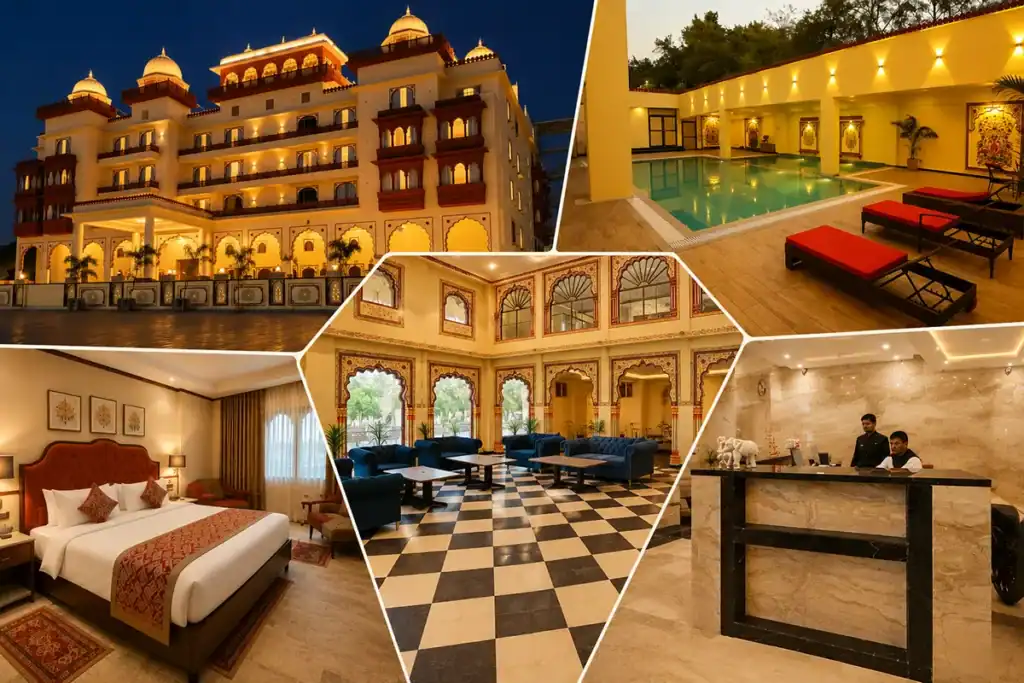
Hotel Ranavilas Palace, in Sitapura near JECC, is built around exactly this problem. Its Rajasthani heritage architecture, 85 air-conditioned rooms designed as quiet zones, on-site restaurants and rooftop dining, spa, and pool exist specifically to help travelers land, recover, and only then start exploring – rather than fighting through the city while still running on fumes.
For anyone weighing a luxury hotel near Jaipur airport against something further into town, or simply looking for a luxury hotel in Jaipur that treats your first hour as seriously as your last, it’s worth putting on the shortlist.
Travel fatigue is real, but it’s also solvable – often just by choosing where you land your head first.