

A guide to the 2027 anniversary, history and living heritage
By Hotel Ranavilas Palace, Jaipur, India
Programme information checked on 19 November 2026
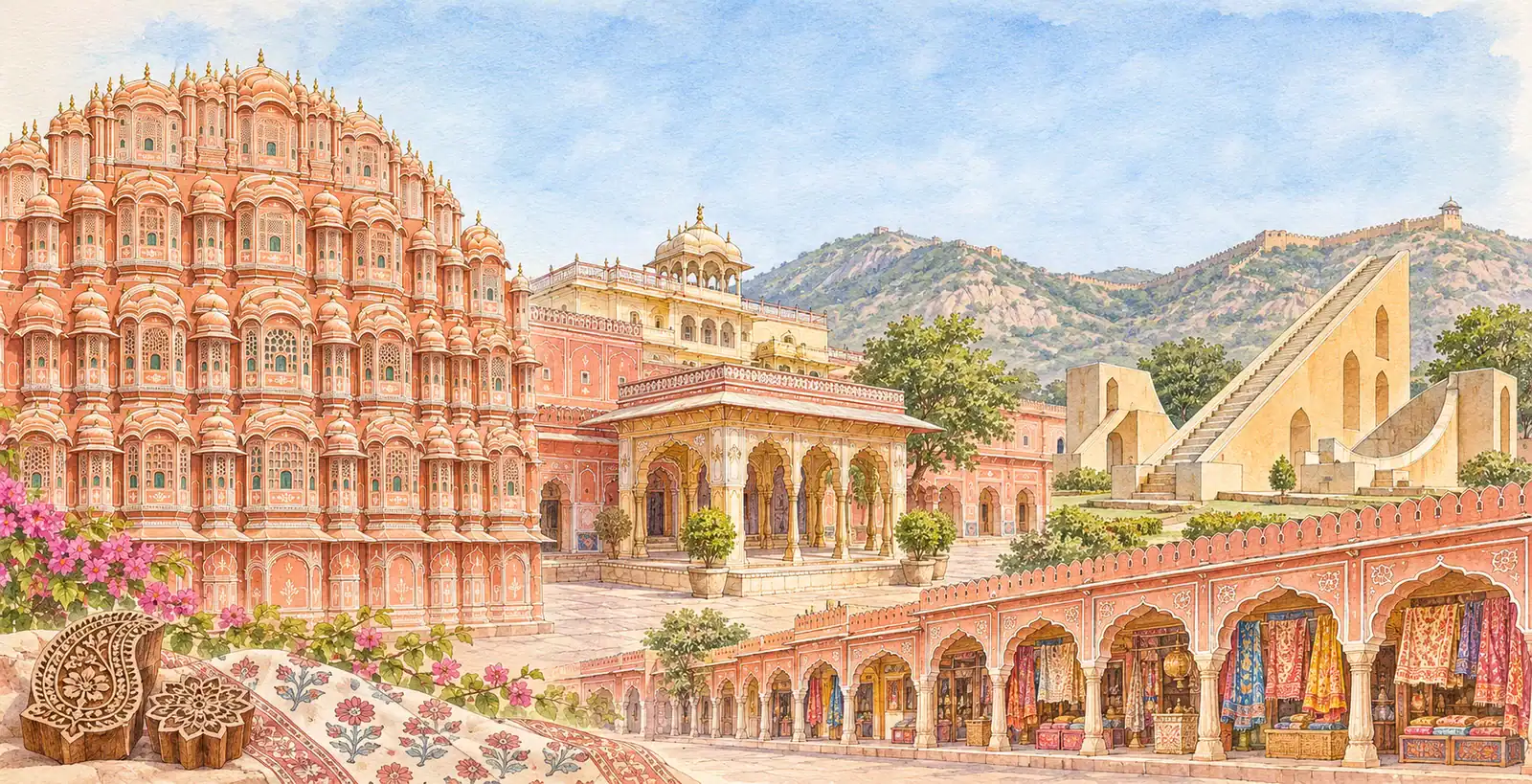
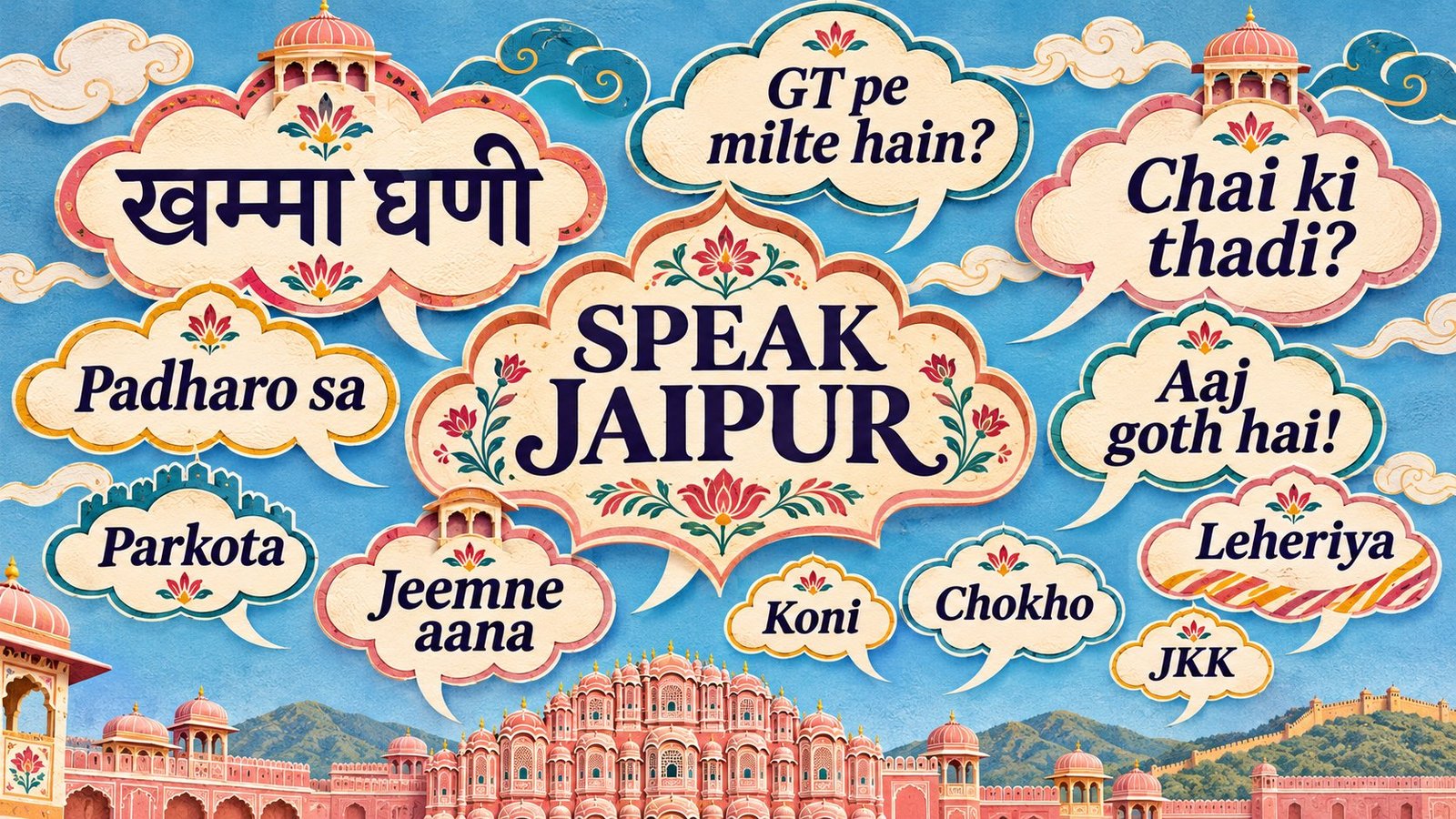
Cover: Digitally generated illustration inspired by Jaipur’s architecture and craft traditions. The landmarks are arranged as an interpretative collage.
Jaipur completes 300 years on 18 November 2027. Founded on 18 November 1727 by Maharaja Sawai Jai Singh II, the city offers a remarkable way to explore how a capital can grow around a plan, a court and a community of makers. [1]
For a visitor, the anniversary is a reason to look more closely. A market street can reveal the logic of the original city. A masonry instrument can explain its founder’s interest in astronomy. A workshop can show how inherited skills continue through working hands.
This guide explains the dates, introduces the history behind the places you can visit, and separates documented announcements from reported celebration plans. The historical sections and the dated programme section can be read independently.
In this guide Dates · History · Celebration plans · Visitor advice · Sources
The anniversary dates explained
The distinction is between entering a year and completing it. On 18 November 2026, Jaipur completed 299 years and entered its 300th year. On 18 November 2027, it completes three centuries. Tricentenary and tercentenary both mean a 300th anniversary.
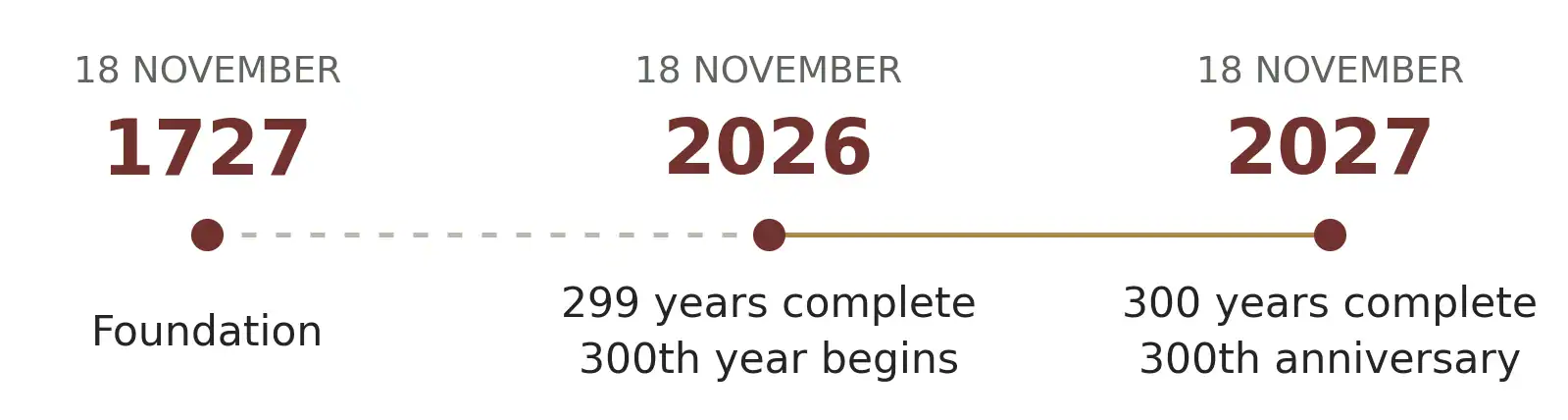
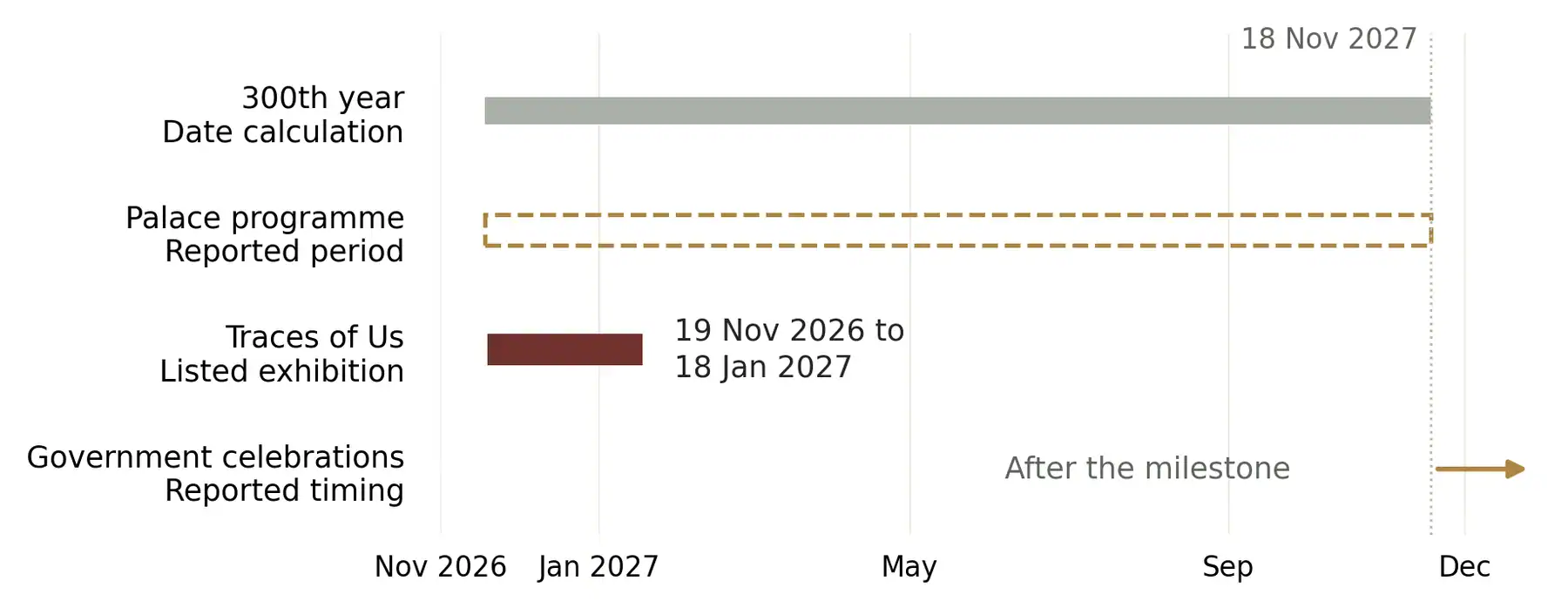
An exhibition or community programme may therefore celebrate Jaipur’s 300th year during 2026-27, while a formal anniversary commemoration may begin after the November 2027 milestone. These are different ways of marking the occasion. The organiser and the published dates matter when planning a visit. [2]
| Key fact | What it means |
|---|---|
| Foundation | 18 November 1727 |
| 300th anniversary | 18 November 2027 |
| Founder and planner | Sawai Jai Singh II; city planning associated with Vidyadhar Bhattacharya |
| Historic World Heritage property | The walled city of Jaipur, inscribed in 2019 |
| Separate heritage recognition | Jantar Mantar became a World Heritage property in 2010; Jaipur joined the Creative Cities Network for Crafts and Folk Art in 2015 |
Quick reference. Sources [1], [4], [5], [6] and [9].
How the planned capital took shape
Before Jaipur, the royal capital was at Amber, also written Amer, in the hills. Rajasthan Tourism describes growing population and water scarcity among the reasons for moving to a new city on the plains. Jai Singh II worked with the planner Vidyadhar Bhattacharya to create the capital that took his name. [6]
The ICOMOS evaluation describes a deliberate grid of broad streets meeting at right angles, with coordinated street facades. It places the design within an exchange of Hindu, Mughal and contemporary Western ideas. Jaipur’s planning can be understood through that wider conversation about how a city should work. [3]
Trade was part of the design. The main avenues became markets, while public squares called chaupars gave the street network places to meet and open out. Looking along a bazaar, then stepping into a smaller lane, makes the change of scale easy to notice. The plan becomes something you can read while walking. [3]
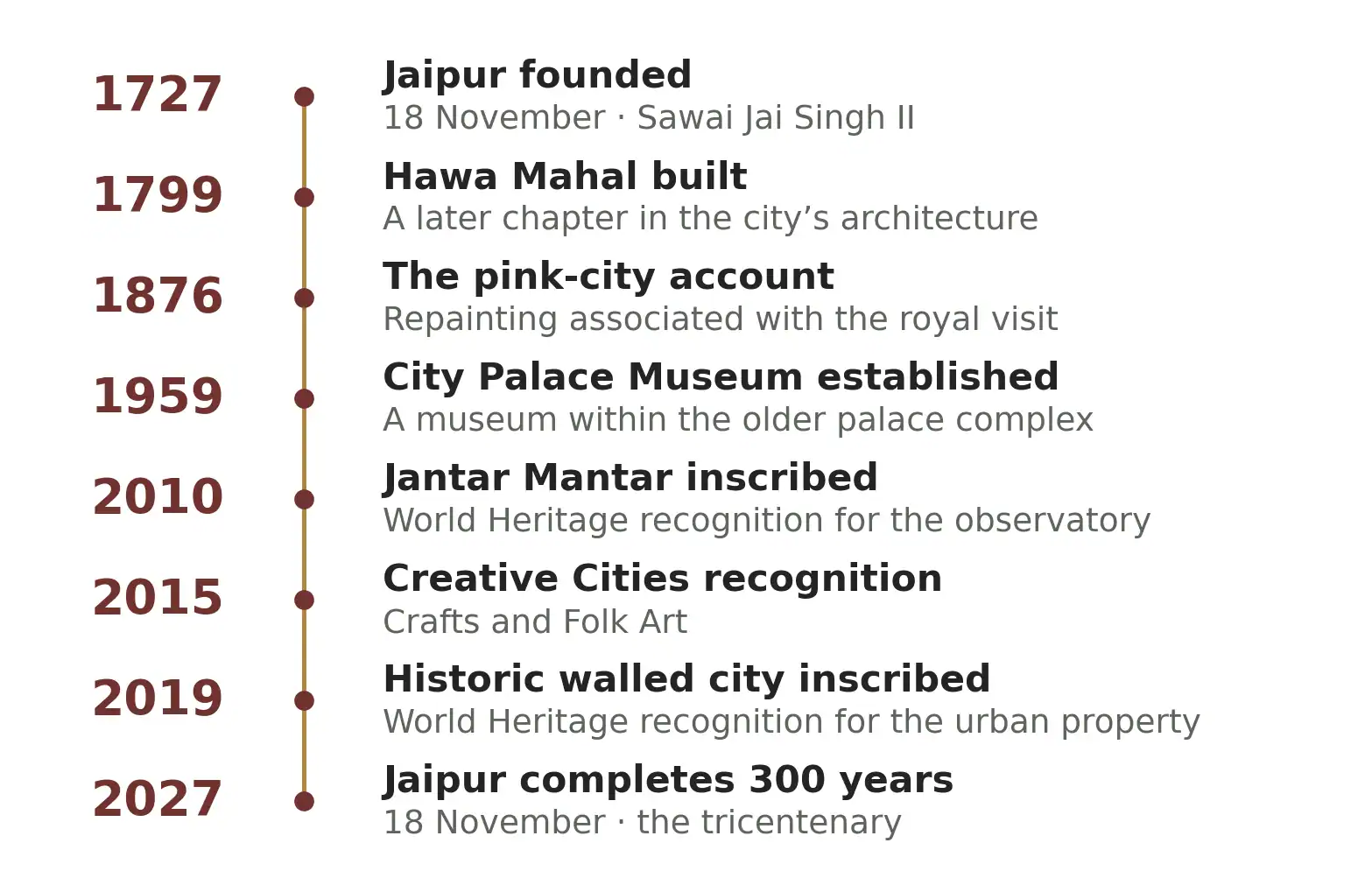
What three centuries look like on the ground
An observatory that makes astronomy visible
At Jantar Mantar, the relationship between architecture and observation becomes tangible. UNESCO describes the early eighteenth-century site as a collection of monumental masonry instruments designed to observe astronomical positions with the naked eye. The forms have a practical purpose: they were built to measure, observe and calculate. [5]
Give the observatory time within your day. Choose one instrument and ask a guide to explain what is being observed, where a reading is taken and why its shape matters. A clear explanation of one instrument is a satisfying introduction to the whole site.
A pink identity with a later chapter
The founding of Jaipur and its familiar pink-city identity belong to different moments. Rajasthan Tourism associates the city’s pink repainting with the Prince of Wales’s visit in 1876, under Maharaja Ram Singh. Seen within a longer timeline, colour becomes one chapter in a city that had already been developing for generations. [6]
A famous facade added by another generation
Hawa Mahal dates to 1799 and the reign of Sawai Pratap Singh. Its latticed openings allowed women of the royal household to observe activity outside while maintaining privacy. The building is an invitation to see Jaipur as a place shaped by successive generations of architecture and patronage. [7]
Collections that bring people into the story
Inside City Palace Museum, maps and photographs offer a different scale of history. Its brochure highlights glass negatives made by Sawai Ram Singh II and the large silver Gangajalis that accompanied Sawai Madho Singh II to England. Objects such as these connect the public city with the interests, customs and journeys of individuals. [8]
Choose a collection that interests you and spend time with its labels. A map, a photograph or a piece of clothing can give a visit a focus that stays with you after the larger rooms and courtyards begin to merge in memory.
Living heritage beyond the monuments
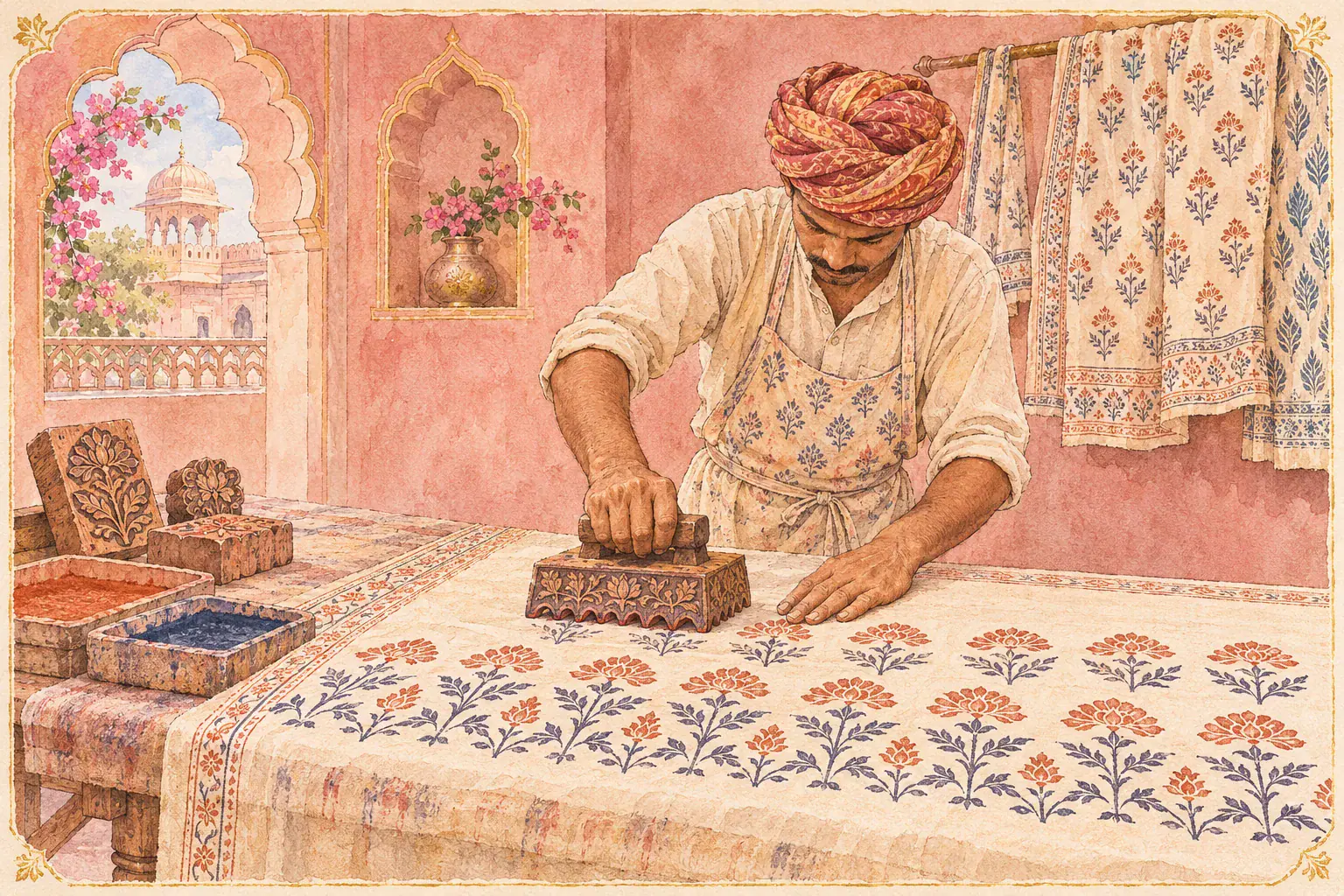
Jaipur’s creative identity also belongs to its makers. UNESCO’s Creative Cities profile identifies a longstanding relationship with crafts such as painting, carving and jewellery. Its Crafts and Folk Art designation, received in 2015, recognises a different aspect of the city from its World Heritage monuments and townscape. [9]
When looking at a handmade object, ask about the material, the process and the work done by hand. With textiles, ask which printing method was used and how to care for the fabric. With a craft demonstration, check that visits and photography are welcome before making the journey. These questions create a useful conversation with the people doing the work.
The same care applies to the historic centre. Streets contain homes, workplaces and places of worship as well as visitor attractions. Leave shop entrances and residential doorways clear, follow instructions at religious sites and ask before photographing people at close range.
Understanding the heritage recognitions
Three UNESCO references often appear in Jaipur travel writing. Jantar Mantar is a World Heritage property in its own right, inscribed in 2010. Jaipur joined the Creative Cities Network for Crafts and Folk Art in 2015. The historic walled city was inscribed on the World Heritage List in 2019. [4], [5], [9]
The walled-city inscription relates to the defined historic property and its attributes. Modern Jaipur extends much farther. Knowing that distinction helps you connect descriptions of the heritage core with the larger city in which you are travelling. [4]
What is planned for the anniversary
Programme information in this section was checked on 19 November 2026. A budget announcement establishes an intention; a news report records a stated plan; an organiser’s dated listing gives more specific information about a visit. Read each item with its evidence and date in view.
The government festival announcement
Paragraph 42 of Rajasthan’s 2025-26 Budget Speech announced Govind Dev Ji Kala Mahotsav, with year-round cultural programmes linked to Jaipur completing 300 years in 2027, and proposed expenditure of Rs 50 crore for this purpose. This is a budget announcement; it does not establish expenditure already incurred or provide a complete visitor timetable. [10]
The revised government timing in news reports
An April 2026 PTI report described a proposed start around November 2026. Later reporting changes that picture. First India on 13 October quoted the Tourism Commissioner explaining that formal government celebrations would follow completion of the milestone. The Times of India on 3 November similarly reported celebrations after 18 November 2027. A final visitor calendar needs a subsequent, specific announcement. [1], [2], [11]
Palace programmes and museum planning
The Times of India reports a palace-led anniversary programme from 18 November 2026 to 18 November 2027. Separately, the City Palace Museum’s own website describes restoration and redevelopment planning connected with the anniversary. These sources establish a reported programme period and an institutional intention; individual exhibitions and activities need their own details. [2], [12]
A named contemporary art exhibition
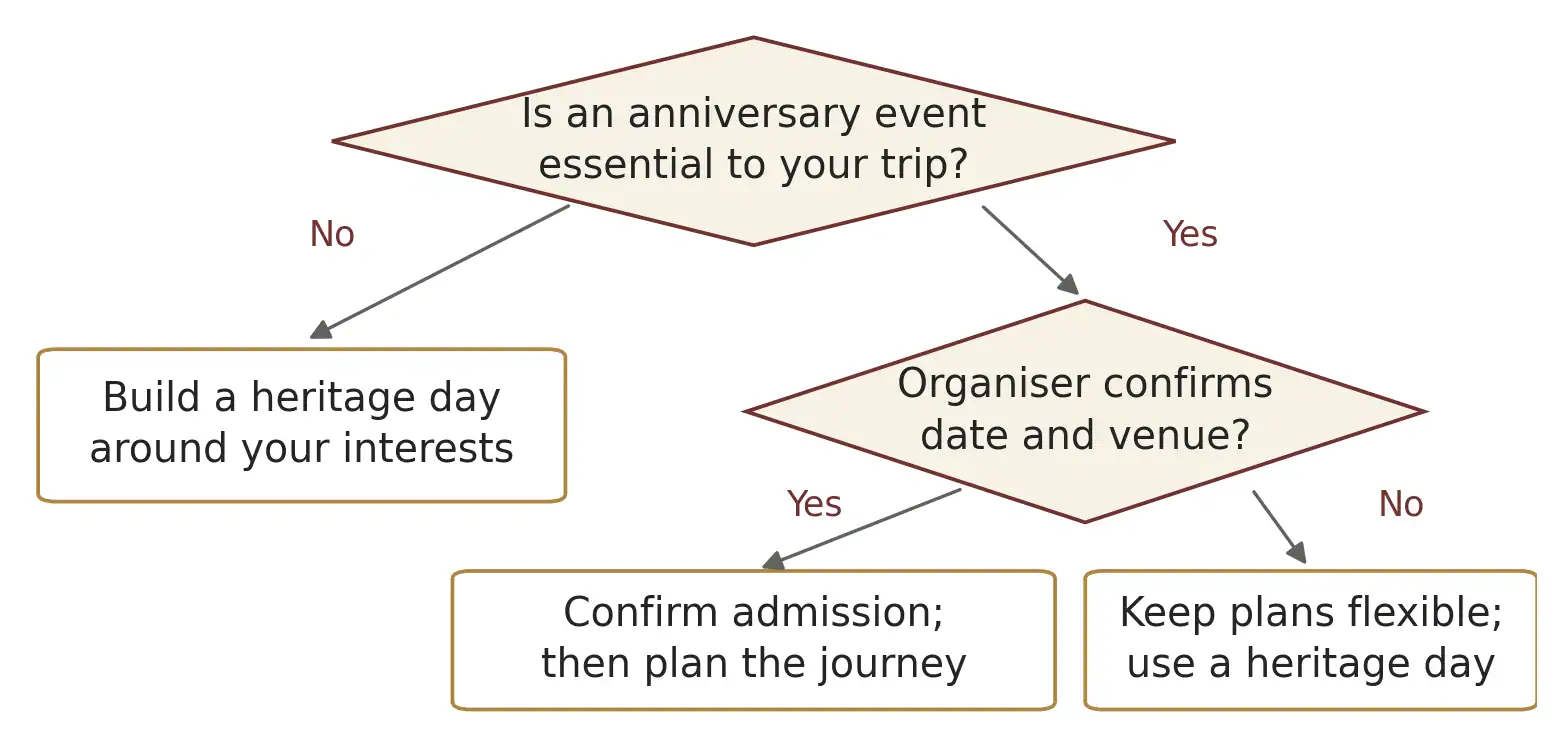
Jaipur Centre for Art announces Traces of Us across City Palace, featuring six artists. India Art Fair lists 19 November 2026 to 18 January 2027. Galleria Continua’s Shilpa Gupta listing also names the Sculpture Park at Jaigarh Fort. Check the organiser’s venue and admission details for the work you wish to see. [13], [14], [18]
Community participation and heritage learning
In INTACH’s report of the Jaipur FILMIT festival held at The Palace School on 6 February 2026, Sandeep Sethi outlined plans to mark Jaipur’s anniversary with a quiz, a FILMIT programme, teachers’ workshops and a festival finale. The entry describes plans, without providing a public schedule for those activities. [15]
Regular festivals, exhibitions and cultural events may also fall during the anniversary year. Check whether an organiser explicitly connects an event to Jaipur’s tricentenary before describing it as part of an official anniversary programme.
Planning a visit around the history
National Geographic includes Jaipur in its Best of the World 2027 selection and connects the city with its anniversary, literature and craft traditions. For your own visit, choose the experiences that interest you and use confirmed programme details when fixing an event-led itinerary. [16]
A first day in the historic centre
Group Hawa Mahal, City Palace and Jantar Mantar within your planning for the central heritage area. Check current opening arrangements and tickets before deciding their order. Leave time for a bazaar walk and one unhurried museum or observatory visit. A shorter list gives you room to understand what you are seeing. [5], [7], [8]
A second day shaped by your interests
Choose a deeper museum visit, a pre-arranged craft experience or a confirmed cultural programme. Ask about the location and format before travelling: an exhibition, a school workshop and an open public performance have different access arrangements. Keep a comfortable margin between a fixed event and your onward journey.
Hotel Ranavilas Palace is in Sitapura, Jaipur, near JECC. Include travel to and from the historic centre in your day’s plan, and check the current route for your dates. You can explore our rooms and suites separately while keeping this guide open. [17]
Rooms and suites at Hotel Ranavilas Palace
Questions travellers often ask
Does Jaipur turn 300 in 2026 or 2027?
The 300th anniversary falls on 18 November 2027. The year leading to that anniversary began on 18 November 2026, when the city completed 299 years. [1]
Is every Jaipur landmark 300 years old?
Buildings and institutions have their own dates. Hawa Mahal, for example, was built in 1799, and City Palace Museum was established in 1959. The anniversary marks the founding of the planned city. [7], [12]
Is there one confirmed calendar for the whole anniversary?
The sources checked for this guide provide announcements, reported programme periods and individual event listings. They do not establish one complete final calendar for all government, palace and community activities. Confirm a particular event with its named organiser.
Can the anniversary help explain the city to a first-time visitor?
Yes. Use it as a framework: begin with the planned streets, explore an instrument or a collection, and make time for a living craft. Then add an anniversary event if its dates and access suit your visit. The history gives the journey a focus even when programme details change.
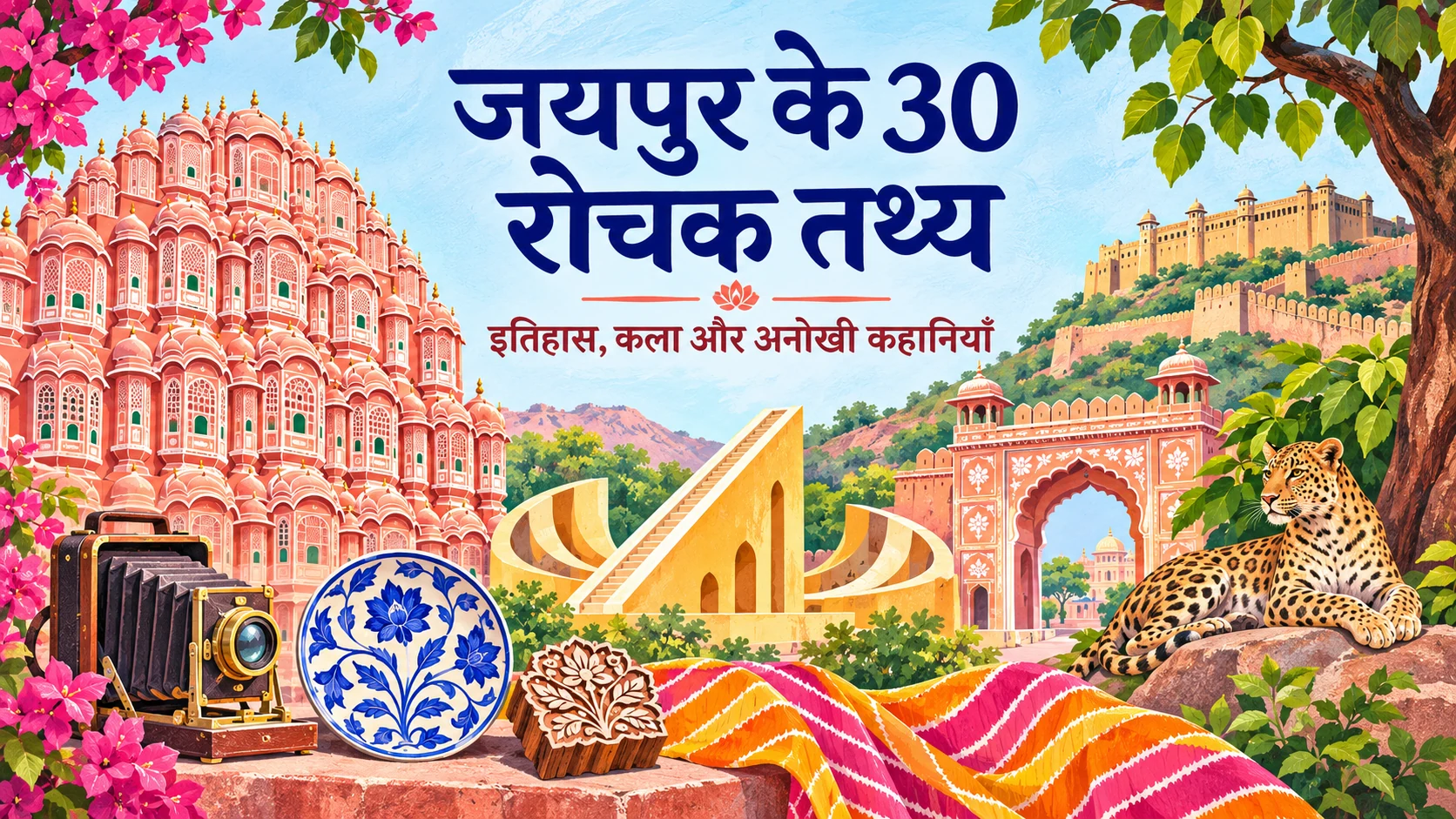
For more of the city’s history, craft traditions and unusual stories, explore our Hindi guide: जयपुर के 30 रोचक तथ्य.
Sources and further reading
The numbered references distinguish heritage records, museum material, government announcements and news reporting. Reference links open separately. Programme details are a dated snapshot checked on 19 November 2026; the linked organiser remains the place to confirm a visit.
- Jaipur founding date and the original anniversary announcement. PTI via ThePrint, 3 April 2026. Used for the founding date. Later reports revise the government programme timing.
- Government timing and the reported palace programme. The Times of India, 3 November 2026. Distinguishes the state timetable from the palace anniversary year.
- Jaipur City evaluation. ICOMOS, 2019, hosted by UNESCO. Evidence for the planned city and its architectural influences.
- Jaipur City Rajasthan. UNESCO World Heritage Centre. The historic walled city, its living commercial character and its 2019 inscription.
- The Jantar Mantar Jaipur. UNESCO World Heritage Centre. The observatory and its separate World Heritage inscription in 2010.
- Jaipur destination guide. Department of Tourism, Government of Rajasthan. The move from Amber, the planner and the 1876 pink-city account.
- Hawa Mahal. Incredible India, Ministry of Tourism. The 1799 building and its architectural context.
- City Palace Museum brochure. Maharaja Sawai Man Singh II Museum Trust. Collections including historic photographs, maps and the silver Gangajalis.
- Jaipur in the Creative Cities Network. UNESCO. Crafts and Folk Art designation in 2015 and the city’s craft traditions.
- Rajasthan Budget Speech 2025 to 2026. Government of Rajasthan, budget speech delivered 19 February 2025; paragraph 42, printed page 43. Announces Govind Dev Ji Kala Mahotsav and proposed expenditure of Rs 50 crore for this purpose.
- Revised government celebration timetable. First India, 13 October 2026. Reporting that quotes the Tourism Commissioner on the revised timing.
- Our History. City Palace Museum Jaipur. The museum’s 1959 establishment and anniversary-related restoration planning.
- Traces of Us announcement. Jaipur Centre for Art. The organiser’s announcement of the exhibition and its artists.
- Traces of Us Group Show. India Art Fair programme listing. Lists 19 November 2026 to 18 January 2027 at City Palace, Jaipur.
- FILMIT Festival Jaipur report. INTACH Heritage Education and Communication Service. Under “FILMIT FESTIVAL JAIPUR”, 6 February 2026, The Palace School, see the paragraph reporting Sandeep Sethi’s remarks on planned anniversary activities.
- Best of the World 2027. National Geographic, 20 October 2026. International editorial coverage connecting Jaipur with its anniversary year.
- Contact and location. Hotel Ranavilas Palace. The hotel’s address in Sitapura, Jaipur.
- Traces of Us and Shilpa Gupta venue listing. Galleria Continua, 19 November 2026. The participating artist’s gallery lists the Sculpture Park at Jaigarh Fort and the exhibition period 19 November 2026 to 18 January 2027. Confirm work-specific venue and admission with the organiser.

One Response