
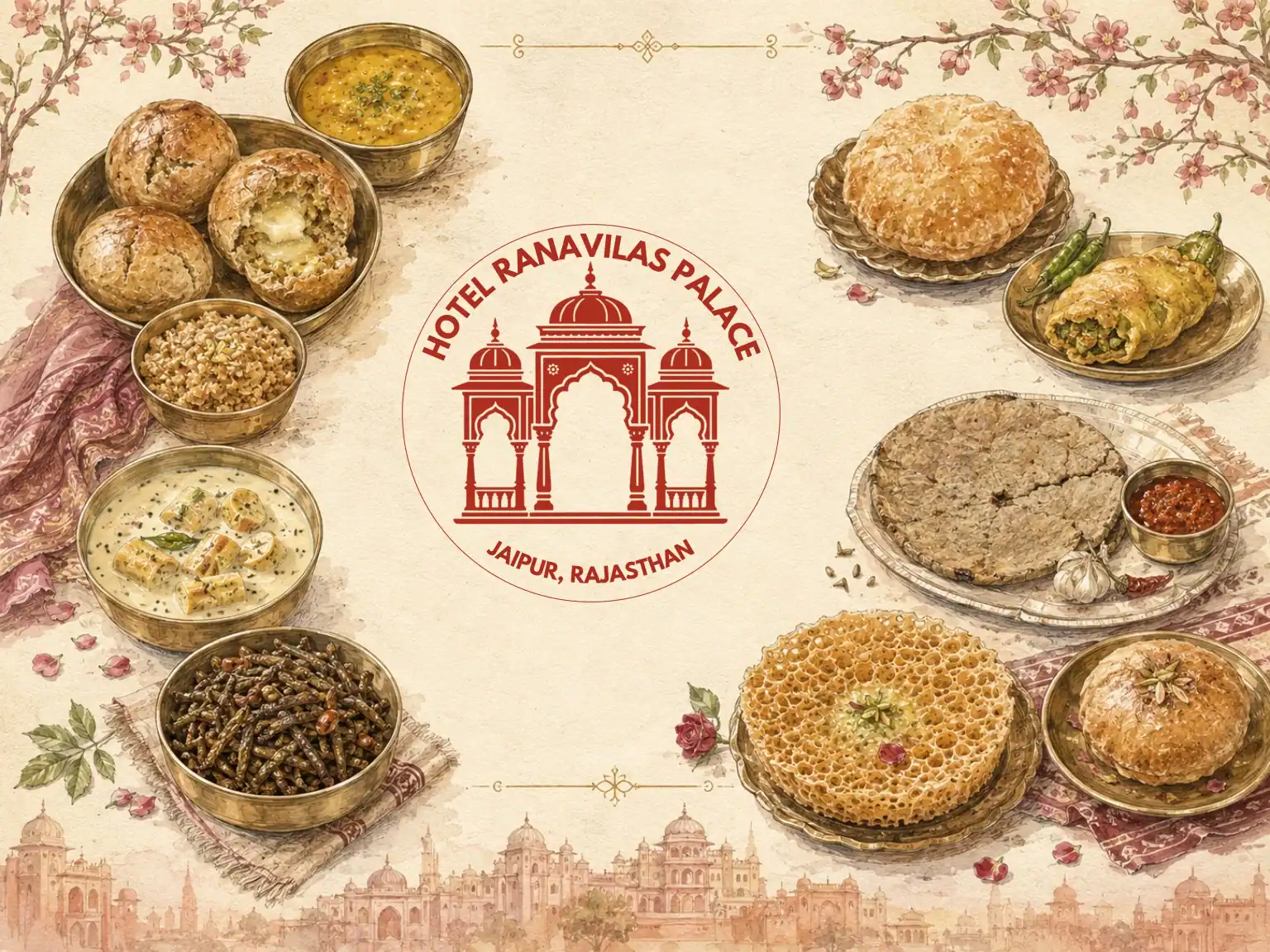

A first-time visitor’s guide to what arrives, why it matters, and how to enjoy it — with a few useful questions to ask before ordering.
If you are wondering what vegetarian food to try in Jaipur, start with the dishes that tell you something about Rajasthan: bread baked until crisp, gram flour turned into tender dumplings, desert pods cooked into a delicacy, and a sweet so lacy that it looks almost woven.
This guide brings together ten Rajasthani favourites you can look for in Jaipur. Some have a particularly strong connection with Jaipur; others, such as mirchi bada and mawa kachori, are closely associated with Jodhpur. Think of Jaipur as a good place to begin exploring the region’s food, rather than the birthplace of everything on the plate.
In this guide: Choose your meal · The ten dishes · Two-day tasting plan · Ordering tips · Common questions
What should you order first?
You do not need ten separate meals to work through this list. A small thali, a shared snack and one sweet are a much more enjoyable introduction.
| If you want… | Start with… | Make it more enjoyable |
|---|---|---|
| One substantial Rajasthani meal | Dal baati churma | Ask how many baatis come in a portion; start with one and add dal gradually. |
| A little of several flavours | A thali with gatte, ker sangri and kadhi | Choose small servings of a dry dish, a gravy and bread or rice. |
| A gentler starting point | Kadhi and rice, made with less chilli | Ask about the tempering too; a mild-looking gravy can still have a hot finish. |
| A freshly cooked snack | Pyaaz kachori or mirchi bada | Share one first and try the filling before adding chutney. |
| Earthy, savoury flavours | Ker sangri with hot bajre ki roti | Keep a little kadhi or curd alongside and take garlic chutney separately. |
| A sweet to share | Ghevar or mawa kachori | Choose ghevar for its lattice-like texture, mawa kachori for its rich milk-and-pastry filling. |
Why Rajasthan’s pantry is so interesting
In the drier parts of Rajasthan, cooks developed an impressive repertoire around ingredients that could be dried and stored: grains, pulses, gram flour, papad and desert produce. That helps explain why a memorable local meal may contain relatively little fresh green produce. Rajasthan’s regional and seasonal cooking is much broader than this shortlist, but pantry ingenuity is a useful thread to follow.3
Notice how one ingredient changes character. Gram flour becomes the dumplings in gatte ki sabzi, helps give kadhi its body, and forms the crisp coating around mirchi bada. Order for contrast — tangy and earthy, soft and crisp, savoury and sweet — rather than simply choosing the richest dishes.
1. Dal Baati Churma — learn the first bite
This is a meal built around three companions: dal, a seasoned lentil preparation; baati, a round, baked wheat bread; and churma, a sweet, crumbly wheat preparation with ghee and sugar or jaggery. The pleasure comes from moving between crisp bread, warm dal and a little sweetness.2
A detail to notice: Churma need not wait until the end as a separate dessert. Try a little alongside the savoury bites. Baati also differs from the soft roti you may be used to: its substantial texture is part of its character.
Try it this way: Break one hot baati into small pieces, spoon dal over a portion and let it absorb briefly. Taste before adding more ghee or garlic chutney. Keep some baati less soaked so you can compare the textures. Ask for extra ghee separately if you prefer to control the richness.
2. Gatte ki Sabzi — besan takes centre stage
Gatte are seasoned gram-flour dumplings, cooked and sliced into pieces before meeting a spiced gravy, often based on yoghurt. Expect a satisfying bite and a tangy sauce; the colour and richness vary by kitchen.3
A detail to notice: There is no paneer inside an ordinary gatta. The dumpling itself is made from besan. Richer or stuffed variations may appear as shahi gatte or Govind gatte, so it is worth asking what distinguishes the version on the menu.1
Try it this way: Cut a piece of gatta, take it with a little gravy, then add a bite of roti. A dry accompaniment such as ker sangri gives the meal more variety than ordering another rich gravy. Ask for the chilli level you actually enjoy; “authentic” does not have to mean ordering the hottest version.
3. Ker Sangri — a closer look at desert ingredients
Ker is a small desert shrub fruit; sangri is the slender edible pod of the khejri tree. The combination is commonly cooked as a dry, tangy sabzi. You may notice a pleasantly chewy texture and a sharper, pickled note, depending on the preparation.1
A detail to notice: Sangri is harvested as a tender green pod and can be processed and dried for later use. The khejri is also Rajasthan’s state tree. This is a particularly direct connection between the landscape outside and the food on your plate.4
Try it this way: Begin with a small serving alongside hot bajre ki roti. Add kadhi or curd for a softer contrast. If the menu says panchkuta, ask about the ingredients: it is a broader preparation using five dried ingredients, with combinations that vary, rather than simply another name for the two-ingredient ker-sangri pairing.4
4. Bajre ki Roti with Lehsun Chutney — eat the bread hot
Bajra is pearl millet. Its flour makes an earthy, substantial roti, different in texture from a wheat chapati. Lehsun chutney brings garlic and chilli to the pairing, so even a small amount can change the character of each bite.6
A detail to notice: Millet is a long-established food grain, not simply a recent restaurant trend. Bajra itself contains no gluten, but a kitchen may use blended flour or shared equipment. If avoiding wheat matters to you, ask how that particular roti is made rather than relying on its name.6
Try it this way: Order one freshly made roti at a time and eat it while warm. Pair a small piece with ker sangri or a little kadhi, then add a dab of chutney. Ghee is a welcome optional addition; jaggery, when offered, gives another savoury-sweet combination to explore. This is an especially satisfying choice on a cool Jaipur evening.
5. Rajasthani Kadhi — taste the tempering too
Kadhi combines yoghurt or buttermilk with gram flour and spices. Rajasthani versions can be wonderfully tangy, but consistency, chilli and additions differ from kitchen to kitchen. Do not assume that every bowl will contain pakoras or taste like the kadhi you know from another region.
A detail to notice: The final tadka, or tempering, may bring a distinct layer of aroma and heat to the surface. A pale colour tells you very little about how much chilli is in the bowl.
Try it this way: Taste a spoonful before mixing it through your rice. Add enough to coat a small portion, then adjust as you go. It also works well alongside a dry dish such as ker sangri. For a gentler meal, ask for less chilli in both the kadhi and its tempering.
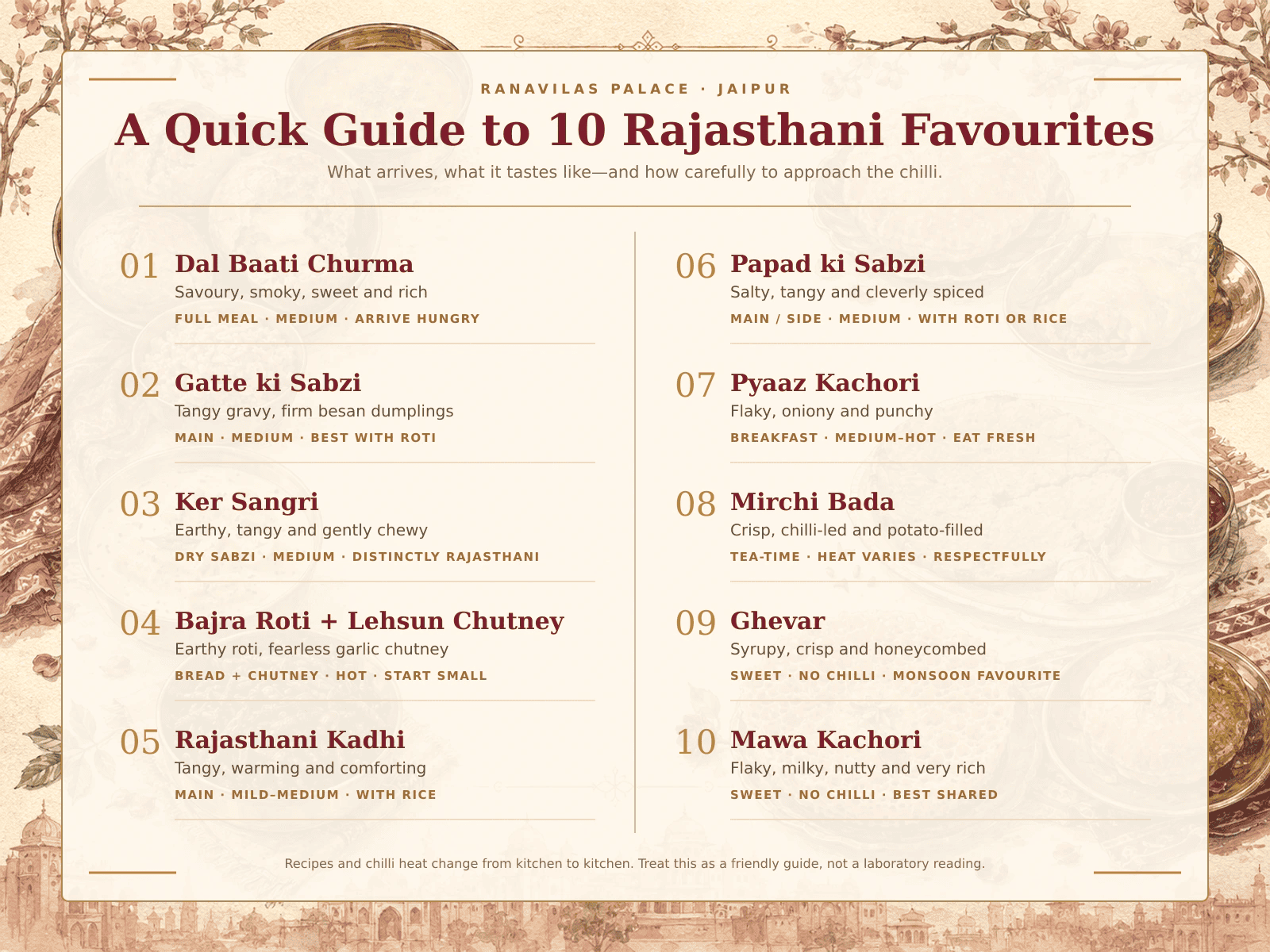
6. Papad ki Sabzi — the crisp side becomes the curry
Here, papad moves from the edge of the plate into the main dish. Pieces are cooked in a spiced gravy, often with curd and sometimes tomatoes. The papad softens as it takes up the sauce, giving the curry a texture unlike a conventional vegetable sabzi.3
A detail to notice: The softened papad is the point of the preparation. If you are expecting the crackle of a freshly roasted papad, this dish will surprise you. Its seasoning also contributes to the overall flavour of the gravy.
Try it this way: Enjoy it soon after serving, with plain rice or roti. Taste the gravy before adding salty pickle or more chutney. If you are sharing several curries, take a small serving first and notice the texture while the papad still has some shape.
7. Pyaaz Kachori — try the filling before the chutney
This flaky, deep-fried pastry has a savoury onion-and-spice filling. It is a satisfying breakfast or snack, especially when freshly cooked. Accompaniments vary: you may be offered a sweet-sour chutney, green chutney or a potato preparation.1
A detail to notice: Pyaaz means onion, and kachori describes a pastry family with several fillings. A dal kachori, pyaaz kachori and sweet mawa kachori are different things. Specify which one you want when ordering from a busy counter.
Try it this way: Break it open and let the centre cool briefly. Taste the pastry and filling together before adding chutney to one portion. Covering the whole thing immediately hides the flavour you came to try. Share one if a thali is planned for lunch. For Jain guests, the onion filling makes this a dish to skip.
8. Mirchi Bada — inspect the chilli, then take a small bite
Closely associated with Jodhpur, mirchi bada is also found in Jaipur. A large green chilli is filled, commonly with spiced potato, coated in gram-flour batter and fried. You may see the name written as mirchi vada; the broad idea is the same.5
A detail to notice: The chilli’s size is not a reliable promise of mildness. Even when a kitchen uses a comparatively mild variety, the filling and chutney add their own seasoning.
Try it this way: Split it lengthways so you can see the layers, let it cool slightly and try a small bite with some filling. Keep chutney separate at first. It is best enjoyed freshly fried, when the coating is crisp, with a cup of tea if you fancy one. The usual potato filling also matters if you follow Jain dietary restrictions.
9. Ghevar — choose for texture as well as topping
Ghevar is a disc-shaped sweet with a delicate, honeycomb-like lattice, dressed with sugar syrup. It is strongly associated with Jaipur and with the monsoon festivals of Teej and Raksha Bandhan. Shops may offer plain, mawa and malai versions.1
A detail to notice: “Plain” means without the richer topping; it does not mean unsweetened. The lattice and syrup are still central to the sweet. Choose plain if you want to focus on that texture, or a topped version if creamy richness is part of the appeal.
Try it this way: Share a small wedge and taste an edge piece as well as a topped centre. Ask when it was prepared and how the shop recommends serving and carrying it. For a take-home purchase, explain your journey and ask about the topping, packaging and storage requirements instead of assuming every version travels equally well.
10. Mawa Kachori — make sure you ordered the sweet one
Mawa kachori is the dessert relative of the savoury snack: fried pastry filled with reduced milk solids, often with nuts and aromatic spices, and finished with sugar syrup. It has a strong association with Jodhpur, although you can look for it in Jaipur’s sweet shops too.5
A detail to notice: Mawa, also called khoya, is milk reduced to solids. It is different from the onion or lentil filling of savoury kachori, even when the pastries look similar from the outside.
Try it this way: Cut or break one into small portions so everyone gets some shell and filling. Taste it before ordering a second dessert. If you have already enjoyed a substantial lunch, sharing one later in the day is a better way to appreciate it than treating it as another full-sized snack.
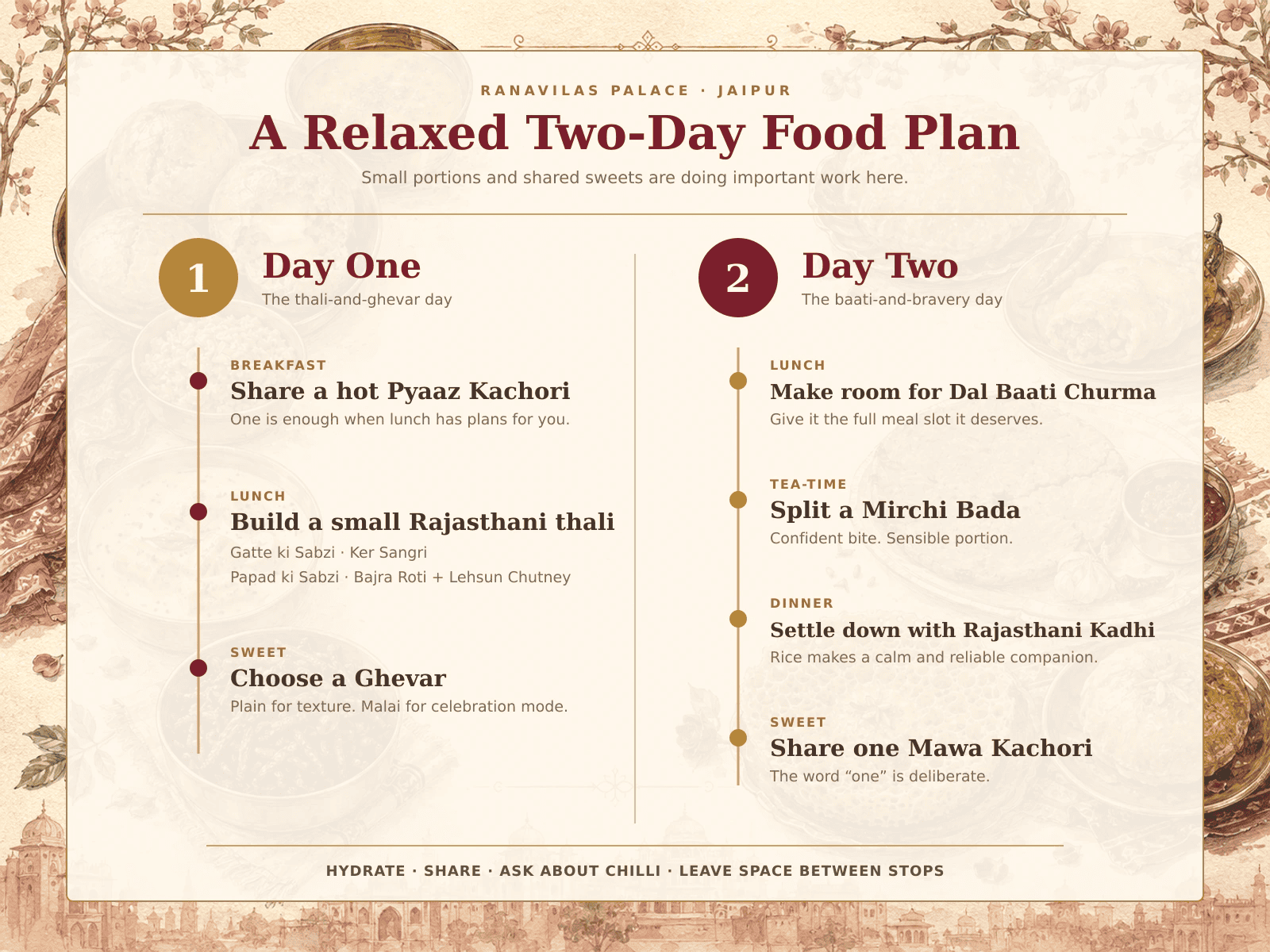
A relaxed two-day tasting plan
Use this as a menu of possibilities, with shared portions and gaps between stops. You can move dishes around to suit your appetite and what is freshly available.
| When | Day one: a thali and a sweet | Day two: baati and a snack |
|---|---|---|
| Breakfast | Share a freshly cooked pyaaz kachori. | Keep breakfast simple if dal baati churma is planned for lunch. |
| Lunch | Try small portions of gatte, ker sangri and papad ki sabzi with hot bajra roti. Take chutney separately. | Give dal baati churma a proper meal slot and begin with a modest serving. |
| Later in the day | Share a wedge of ghevar when you have room. | Share a fresh mirchi bada with tea; save a small mawa kachori tasting for later if you wish. |
| Dinner | Choose according to appetite; there is no need to complete a checklist. | Try kadhi and rice, with the chilli level agreed before ordering. |
Small questions that make a better meal
Ask for less chilli clearly
“Less chilli, please — and chutney separately” is more useful than asking whether something is “too spicy”. Taste the food before adding pickle, chilli or chutney. If you enjoy a little heat, increase it gradually rather than starting with everything mixed together.
Explain Jain requirements dish by dish
Vegetarian and Jain are not interchangeable menu labels. Pyaaz kachori contains onion, lehsun chutney contains garlic, and mirchi bada commonly contains potato. For curries, check the gravy, tempering, fillings and accompaniments. Tell the kitchen your exact exclusions before ordering; removing a garnish will not change ingredients already cooked into a dish.
Check dairy even in savoury dishes
Ghee, curd, buttermilk, mawa and cream appear throughout this list. A vegetarian dish is not automatically vegan. If you have an allergy or another ingredient restriction, explain it directly and ask the kitchen to confirm the recipe and preparation.
Order for freshness and contrast
Ask what has just been cooked. Eat fried snacks while their coating is crisp, enjoy bajra roti hot, and choose a gravy alongside a dry dish. For sweets you plan to carry home, ask the seller about that particular preparation’s storage needs and your travel time.
Try a little before ordering more
A thali can be a useful introduction because you can compare small servings. Ask what is included and whether portions can be shared or replenished; arrangements differ. Order a manageable first round, then go back to the dish you most enjoyed.
A few questions guests often ask
Which three dishes should I try if time is short?
Our starting combination would be dal baati churma, a small serving of ker sangri, and a shared wedge of ghevar. Together they introduce a substantial meal, distinctive desert ingredients and one of Jaipur’s best-known sweets. Spread them across separate stops if that suits you better.
Is all Rajasthani vegetarian food very spicy?
Chilli levels depend on the recipe and the kitchen. A less-chilli kadhi with rice can be a gentler starting point; garlic chutney and mirchi bada need a more cautious first taste. Ask about both the dish and the accompanying chutneys.
Are all ten dishes Jain or vegan?
No. Several contain onion, garlic, potato or dairy, and the same dish can be prepared differently elsewhere. Use the ordering notes above and confirm your requirements with the kitchen before the meal is prepared.
Can I order every dish at Hotel Ranavilas Palace?
This is a guide to food you can explore in Jaipur, rather than a statement of our daily menu. Hotel Ranavilas Palace is a 100% vegetarian property with Jain menu options available. Ask our team about the current menu, seasonal preparations and your dietary preferences.
Make a little room for discovery
You may arrive looking forward to dal baati churma and leave talking about ker sangri. Or discover that your favourite bite was a piece of hot roti with just a little chutney. Start with small portions, ask a few questions and give yourself time to enjoy the differences.
For ideas between meals, explore our three-day Jaipur itinerary, browse the Jaipur shopping guide, or open the Ranavilas Jaipur Guide. If you are planning your visit, explore Hotel Ranavilas Palace and let us know what you would most like to taste.
Food notes and further reading
Regional names, ingredients and methods vary by household and kitchen. The tasting suggestions are our editorial recommendations; the cultural and ingredient notes draw on the sources below.
1. Rajasthan Tourism — Rajasthani cuisine: regional dishes, gatte variations, kachoris, ghevar and festival associations.
2. Incredible India — Rajasthan: dal baati churma and regional food traditions.
3. Uttarakhand Open University — Regional Cuisines of India I, Rajasthan unit: pantry traditions, gatte and papad ki sabzi.
4. Rajasthan Foundation — Khejri, State Tree of Rajasthan: edible pods, storage and panchkuta.
5. Incredible India — Jodhpur’s culinary traditions: mawa kachori and mirchi vada.
6. ICAR — Indian Farming, January 2023 millet issue: pearl millet and traditional preparations.


One Response