

At least once a week, someone at our front desk asks a version of the same question: “We’ve only got three days in Jaipur – what should we actually do?”
We get why they’re asking. Jaipur has a way of turning even a short holiday into a list of fourteen must-see monuments and three markets you “can’t miss.” Most first-time visitors arrive with a spreadsheet. Few leave without wishing they’d left more room to breathe.
So here’s the honest version – the one we’d give a friend staying with us for three days, not a checklist copied from a guidebook. It still covers the icons, because they’re icons for good reason. But it leaves space for the parts of Jaipur that never make it onto a Google search: a stepwell at 7 a.m. with nobody else around, a tea stall conversation that runs long, a wrong turn that turns out to be the best part of the day.
Day One: Meeting the Jaipur Everyone Comes For
Amer Fort, before the tour buses arrive
Start at Amer Fort, and start early – ideally before 8 a.m. This isn’t guidebook superstition. Amer at sunrise is a genuinely different place from Amer at noon: the light falls softer across the sandstone, the courtyards are still quiet, and for an hour or two the fort feels less like a ticketed attraction and more like the palace it once was.
On your way out, don’t rush past Panna Meena ka Kund. Everyone stops here for the photograph – the symmetrical steps make for an easy Instagram shot – but it’s worth standing still for a minute longer than that. The stepwell has been watching visitors do exactly this for a few hundred years.
The old city, at a walking pace
Spend your afternoon in the walled city: the City Palace, then Jantar Mantar. The observatory tends to surprise people. It’s easy to walk in expecting a curiosity and walk out doing the mental math on how anyone tracked planetary movements this precisely without a single screen involved.
By evening, put the car away and walk through Johari Bazaar and Bapu Bazaar instead. Most visitors treat the old city bazaars as a shopping errand. We’d suggest treating them as the main event. Watch how a negotiation actually unfolds. Notice how many of these shops are being run by the third or fourth generation of the same family. That’s Jaipur too – not just the forts, but the families still running businesses out of buildings older than most countries.
Day Two: The Jaipur Locals Actually Know
A quiet start at Gaitore
Gaitore ki Chhatriyan doesn’t get anywhere near the footfall of Amer or Hawa Mahal, and that’s precisely the appeal. These royal cenotaphs are some of the most beautifully carved structures in the city, and on most mornings you’ll have long stretches of them almost entirely to yourself – just marble, birdsong, and the occasional camera shutter.
Albert Hall, and the garden around it
From there, head to Albert Hall Museum. Even travellers who aren’t usually museum people tend to come around once they see the building itself – it’s worth the visit for the Indo-Saracenic architecture alone. Give yourself time afterward to walk the surrounding gardens rather than heading straight back to the car.
Get intentionally lost
This might be the single most useful thing in this whole guide: pick a lane in the old city with no destination in mind, and just walk. Turn wherever something catches your eye. The best discoveries in Jaipur are rarely the ones with a ticket counter – they’re the havelis tucked behind the main market street, the workshop where someone is still hand-block-printing the same way their grandfather did, the courtyard you’d never have found on a map.
Close the day at a busy local chai stall rather than another monument. Order a cutting, stand at the counter, and just watch. Twenty minutes here will tell you more about how Jaipur actually lives than most of what’s written about it online.
Day Three: Jaipur From Above
Start at Patrika Gate. Yes, it shows up on every Jaipur Instagram feed you’ve ever scrolled past – but it earns the attention. The scale and colour of the artwork are genuinely worth seeing in person. Jawahar Circle is right nearby if you want an easy, unhurried walk afterward.
Keep your afternoon loose. By day three, you’ll almost certainly have a shortlist of places you want to revisit, or a recommendation from someone you met the day before. This is where over-planning quietly ruins a trip – leave room for a café you weren’t expecting, a market stall, a conversation with a stranger that turns into the best story you bring home.
Save Nahargarh Fort for sunset. It isn’t a secret – every local and every guidebook will point you here – and it still manages to earn the hype every single time. Watching the entire Pink City spread out below you as the light turns gold is one of those experiences that doesn’t dull with familiarity.
A Few Things the Guidebooks Skip
- Jaipur is bigger than it looks on a map. Traffic can turn a “fifteen-minute” drive into forty-five, especially between 5 and 8 p.m. Build in extra time.
- Every local has a strong opinion on the best kachori in the city. Ask five people and you’ll get seven confident, contradictory answers. Try a few of them yourself.
- Start early whenever you can. The gap between an 8 a.m. visit and an 11 a.m. visit is enormous – for the light, the temperature, the crowds, and your own energy by the afternoon.
- You don’t have to “finish” Jaipur. Leave a few things undone. It’s a good excuse to come back.
Where to Rest Between All That Walking
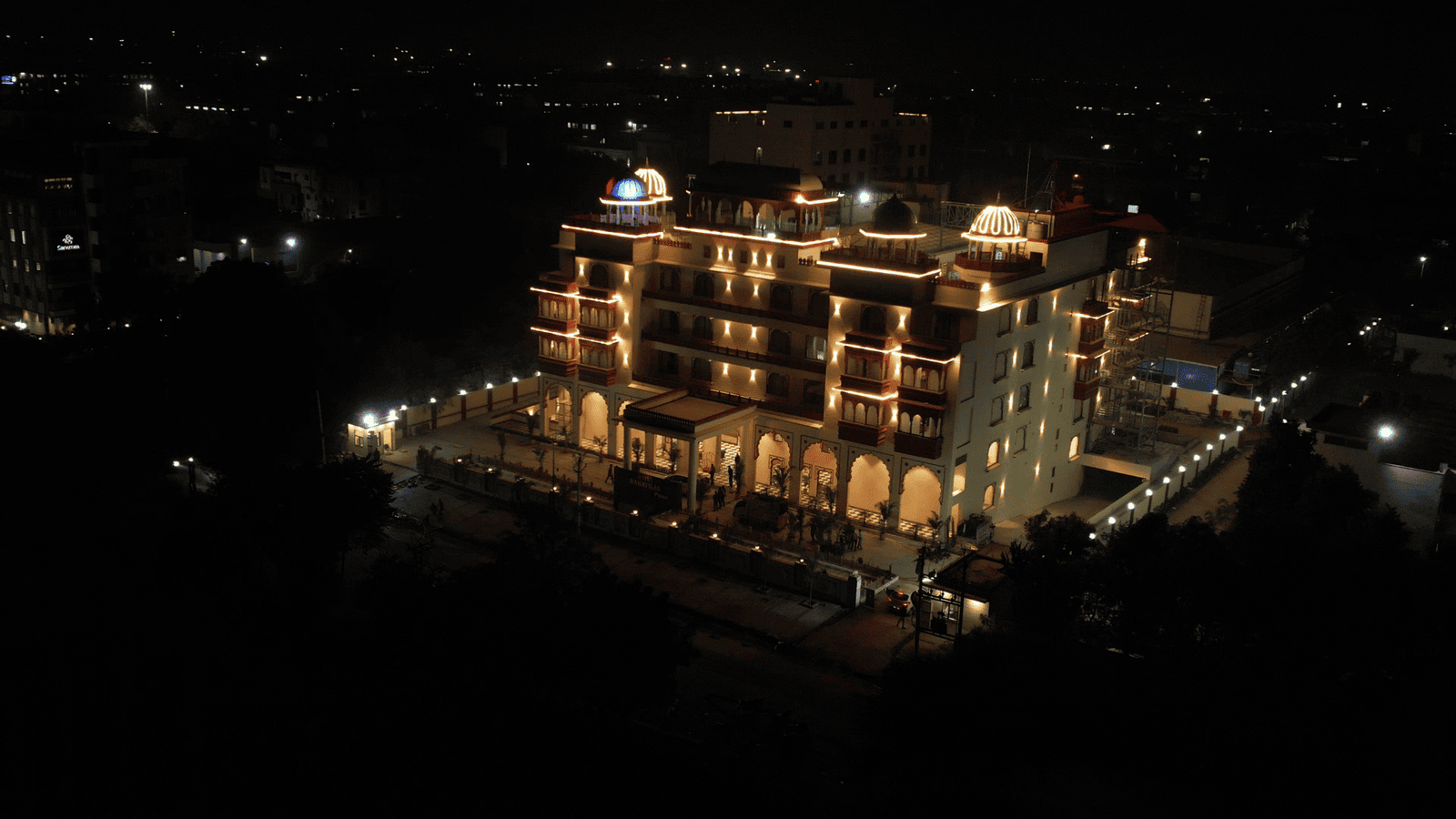
Three days of forts, bazaars and long walks call for somewhere quiet to return to in the evening – and this is usually where we get to talk about home turf. Ranavilas Palace is built in the same Rajasthani heritage style as the monuments you’ll be spending your days in, with the kind of calm courtyards and old-world detailing that make the transition from “sightseeing” to “resting” feel like part of the same story, not a jarring switch to a generic hotel room.
If you’re weighing up where to stay in Jaipur for a trip built around slow mornings and long evenings, a heritage property that matches the pace of the itinerary tends to make the whole three days feel more coherent – and gives you a genuinely restful base to plan the next day’s wandering from.
The forts are extraordinary. The architecture is genuinely one-of-a-kind. But ask most people what they actually remember about Jaipur a year later, and it’s rarely the ticket stub from a monument. It’s a cup of chai. A market lane. A conversation with a shopkeeper. A wrong turn that became the best hour of the trip.
Leave room for those, and Jaipur tends to give generously in return. And if you find yourself wishing you’d booked a fourth day – that happens to almost everyone.
We’ll be here when you’re ready to come back.