
From chai ki thadi to GT pe milte hain
By Hotel Ranavilas Palace · Jaipur, India
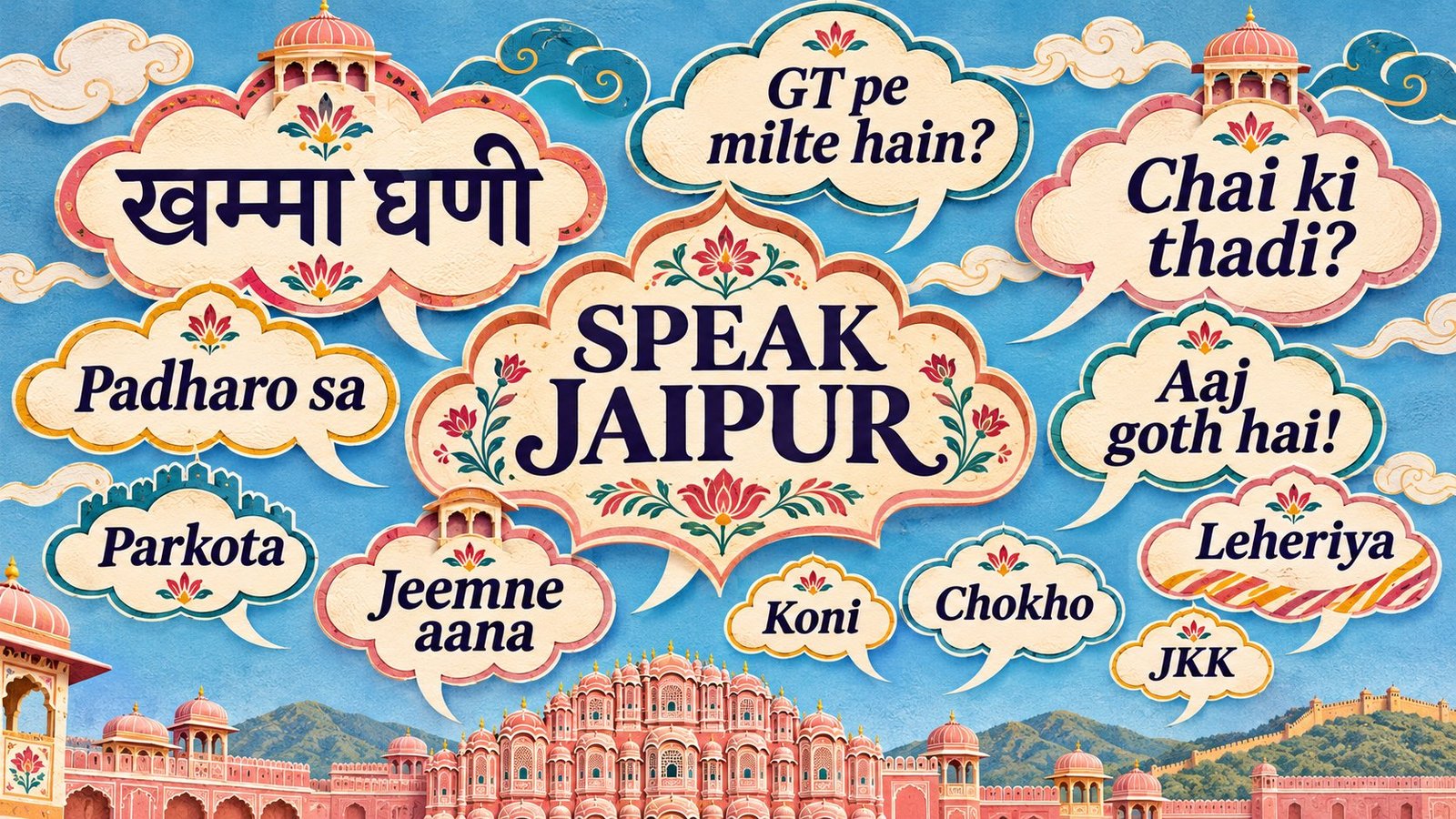
Cover image: digitally generated illustration inspired by Jaipur architecture and the words explored in this guide.
“GT pe milte hain. JKK ka bhi plan hai? Aur Sunday ko goth?”
If that sounds like a meeting invitation with half the information missing, this guide is for you. There is a shopping landmark in there, an arts centre and a gathering built around food. Once the short forms and local words begin to make sense, so do a surprising number of Jaipur conversations.
You can explore the city perfectly well without learning a new vocabulary. But knowing what a friend means by parkota, why somebody has invited you to jeemna, or which place they mean by SMS makes the day easier. It also gives you better questions to ask over the next cup of chai.
A small note before we start talking
Jaipur's speech has several layers. Everyday Hindi and Hinglish sit alongside Dhundhari, also called Jaipuri, and words shared with other Rajasthani varieties. Dhundhari belongs to the Jaipur region; Marwari is associated primarily with western Rajasthan. A visitor will hear overlaps, family preferences and different accents. 1, 2
Some entries below are regional expressions, some are ordinary Hindi words with useful Jaipur connections, and others are names shortened into a few letters. They belong in different categories. A chaupar is a place, khamma ghani is a greeting, and JKK is an initialism. Calling all three “slang” would miss much of the fun.
The example conversations use simple Hindi and Hinglish, with English meanings. Roman spellings are approximate, and regional endings can change with grammar and the speaker. Treat this as a friendly visitor's guide rather than a script you have to recite.
Start with a hello
A greeting you can say comfortably is a good beginning. Namaste is widely understood. These expressions add a little more context to what you may hear in Jaipur and elsewhere in Rajasthan. 3
| Word or expression | What it conveys | A situation in which it fits |
|---|---|---|
| Khamma ghani / खम्मा घणी | A traditional respectful greeting associated with Rajasthan. | Greeting someone in a traditional Rajasthani setting. Listen to the reply; families and communities have their own habits. |
| Ram Ram / राम राम | A familiar greeting heard across Rajasthan and other parts of northern India. | Returning a greeting during a conversation. You may also hear Ram Ram sa / राम राम सा. |
| Padharo / पधारो | Please come; welcome. | Someone waves you into a shop or invites you to join them: “Padharo!” |
| Ji and sa / जी और सा | Courteous forms used in address. Ji is widespread in Hindi; sa occurs in Rajasthani forms of address. | “Haan ji” means a polite “yes”; “Padharo sa” adds respect to an invitation. |
| Hukum or hokam / हुकुम या होकम | A respectful form of address or acknowledgement in traditional regional usage. | Understanding “Ji, hukum” in a courteous exchange. Its flavour depends on the speaker and relationship. |
| Bhaiya and didi / भैया और दीदी | Literally elder brother and elder sister; familiar forms of address in everyday Hindi. | Politely getting someone's attention. These are shared Indian expressions, rather than words exclusive to Jaipur. |
There is no need to adopt an elaborate accent. Say the expression clearly, smile when it feels natural and let the conversation find its own pace. Knowing someone's name is useful too.
Words that give a conversation its local flavour
These regional words are useful to recognise even before you feel ready to build a whole sentence with them. Their forms and frequency vary between households and areas. Kaai is documented in the linguistic description of Jaipuri; koni is a regional negative, and the other entries belong to the wider Rajasthani vocabulary. 2, 4, 5, 6
| Word or expression | Useful English meaning | How to understand it in context |
|---|---|---|
| Kaai / कांई | What? | A questioning “Kaai?” can be a request to explain or repeat something. Longer sentences give it more context. |
| Chhai / छै | A verb form you may hear where Hindi uses hai. | In Dhundhari speech, listen for छै at the end of a sentence. It is part of the grammar; it is not a word to add to every sentence. |
| Koni / कोनी | Not; a negative expression. | Listen to the whole sentence to understand what is being denied. It can appear where a Hindi speaker might use nahin. |
| Ghano or ghani / घणो या घणी | Much, many or very, depending on the sentence. | A word that adds quantity or emphasis. The ending changes; ghani also appears in the familiar greeting khamma ghani. |
| Chokho or chokhi / चोखो या चोखी | Good, nice or fine in regional usage. | An approving reaction to something. The form can change with what is being described. |
| Mhaaro and thaaro / म्हारो और थारो | My and your, with forms that change in use. | Mhaaro Jaipur expresses “my Jaipur”. In a first conversation, familiar Hindi forms such as aap are an easy way to remain courteous. |
| Syaano or syaani / स्याणो या स्याणी | Clever, sensible or knowing; sometimes said teasingly. | Among friends, “Bade syaane ho!” can carry the flavour of “Look at you being clever!” Tone does much of the work. |
| Bawlo or bawli / बावळो या बावळी | Silly or mad; a word whose force depends strongly on context. | You may hear it in teasing between people who know each other well. It can also sound insulting, so recognise the relationship before borrowing the line. |
Those last two words belong to the conversation between established friends. You can enjoy understanding a joke without making a stranger its subject.
A thadi can become the whole afternoon
Thadi / थड़ी means a small street stall. Add chai ki and you have a tea stall. The setting might be modest: a kettle, cups, a few seats and a familiar place to stop. Jaipur's local writing uses both thadi and tapri when talking about tea. 7
Tapri / टपरी can also refer to a small stall in everyday speech. In Jaipur, Tapri is also used in café names, so give a driver the full place name or a map pin. “Tapri chalna hai” may be enough for your friend, but it leaves a new arrival with a follow-up question.
Here is a simple tea-stop conversation. The lines are ordinary Hindi and Hinglish, with a local setting:
Friend: “Chai ki thadi par chalein?”
Shall we go to a tea stall?
You: “Chalein. Bhaiya, do chai dena.”
Let's go. Two teas, please.
Tea seller: “Adrak wali?”
With ginger?
You: “Haan ji, cheeni kam.”
Yes, please, with less sugar.
You now have a useful order, a courteous reply and somewhere to sit while the next part of the day is discussed. If you want a stronger brew, kadak chai is another widely used Hindi expression worth knowing. Explain your preference plainly; everyone has a different idea of the perfect cup.
A goth is a good reason to arrive hungry
Goth / गोठ is a gathering centred on a shared meal. Anjas describes the word in terms of a communal meal, hospitality and a group coming together. It can be associated with an occasion, a pleasant day or an outing with friends and family. 8
“Sunday ko goth hai” therefore tells you something about the plan, but leaves room for a few useful questions. Where is it? What time are people eating? Is it at someone's home, a garden or an organised venue? A goth describes the gathering, rather than one fixed menu or one compulsory kind of place.
Dal, bati and churma are an easy food association, but the invitation itself matters more than guessing the dishes. The delightful part is the prospect of eating together while conversation travels around the group.
Jeemna / जीमना, also heard in regional forms related to jeeman / जीमण, means to eat or dine. An invitation to jeemne aana is an invitation to come and eat. Columbia's language teaching material records jeemna as a regional word for eating. 3
An illustrative message might read:
“Sunday ko goth hai. Jeemne zaroor aana.”
There is a shared meal on Sunday. Do come and eat with us.
The useful reply is a very ordinary one: “Zaroor. Kitne baje?” — “Certainly. What time?” Your vocabulary has improved; your lunch still needs a time and place.
Words hiding in Jaipur's street names
The city starts explaining itself once you recognise a few words in its addresses. Parkota is used locally for the walled-city area, while the chaupars are part of Jaipur's historic plan. UNESCO describes them as large public squares where streets intersect. 7, 9
| Word | What it means here | A useful Jaipur example |
|---|---|---|
| Parkota / परकोटा | The city enclosure or wall; in local conversation, often the historic walled-city area. | “Aaj parkote mein ghoomte hain” — let's explore the old city today. |
| Chaupar / चौपड़ | A large square at intersecting streets in Jaipur's planned old city. | Badi Chaupar and Chhoti Chaupar are different places. Give the full name and an exact meeting point. |
| Chowk / चौक | A square, open public space or junction, depending on the place name. | When someone names a chowk, check which one; the word alone is not an address. |
| Rasta / रास्ता | A way or street; a common Hindi word that appears in many Jaipur street names. | Maniharon ka Rasta is a name to remember when exploring the bangle-making streets. |
| Pol / पोल | A gate or gateway, often encountered in heritage architecture. | At Amer, Ganesh Pol is the name of a particular gateway, rather than another name for the whole fort. |
| Haveli / हवेली | A traditional substantial residence, often arranged around courtyards. | Ask about the individual building. The word alone does not establish public access or a museum. |
| Baori or baoli / बावड़ी या बावली | A stepwell. Forms and spellings vary by region and site. | Recognising the word helps you understand why a place such as Chand Baori is known for its stepped structure. |
The place names reward curiosity. A rasta can point you towards a trade, a pol towards an entrance and a chaupar towards the way the city was organised. For more on that plan, explore our guide to Jaipur's history and its 300th anniversary. 9, 10
For a cab or a meeting, keep the full landmark name and a map pin. Local vocabulary is enjoyable; a clear pickup point is enjoyable for everyone.
Words to take to the sweet shop and the bazaar
Food and shopping supply another useful layer of vocabulary. These terms travel across Rajasthan and beyond; the value here is recognising them when they appear on a Jaipur menu, fabric label or shopkeeper's lips. Rajasthan Tourism and Incredible India document many of these foods and crafts. 10, 11, 12
| Word | What you are looking at | Something useful to ask |
|---|---|---|
| Chaach / छाछ | A buttermilk drink. Seasoning and preparation vary. | “Masala chaach hai?” — do you have spiced chaach? |
| Pyaaz ki kachori / प्याज़ की कचौरी | A fried savoury pastry with an onion filling. | “Kitni teekhi hai?” — how spicy is it? |
| Ghewar / घेवर | A traditional sweet with a distinctive honeycomb-like structure. | Ask whether it is plain or comes with a topping such as malai. |
| Feeni / फीणी | A delicate sweet made in fine strands; spellings include pheni. | Ask how that shop recommends serving it and how to carry it home. |
| Leheriya / लहरिया | A textile style recognised by wave-like stripes, traditionally produced through tie-dye. | “Leheriya dupatta dikhaaiye” — please show me a leheriya dupatta. |
| Bandhej or bandhani / बंधेज या बांधनी | Tie-dye work made by tying portions of cloth, often producing dot patterns. | Ask about the fabric and care instructions as well as the pattern. |
| Lac or lakh / लाख | A resin material associated with bangle-making and decorative work. | “Yeh lac ki choodiyan hain?” — are these lac bangles? Ask the seller to explain the material. |
| Meenakari / मीनाकारी | Decorative enamel work, often seen on jewellery. | “Is par meenakari hai?” — is this enamel work? Ask what metal the piece uses too. |
| Saafa / साफ़ा | A turban; tying styles and use vary with the occasion and region. | At a celebration, ask whether help with tying a saafa is available. |
That small vocabulary makes shopping more interesting. Once you can name the pattern or technique, the conversation can move to how something was made, how it should be worn and how to look after it.
For a fuller outing, use our Jaipur shopping guide. For the food behind the names, our guide to vegetarian Rajasthani dishes gives you more to explore.
When Jaipur starts speaking in letters
“GT pe milte hain” means “Let's meet at GT”. The letters stand for Gaurav Tower, a name its developer also records as the familiar nickname. It is a useful starting point for decoding the city's short forms. 13
The next useful question is: Kaunsa entrance? Which entrance?
| Short form or name | What it refers to | How it helps a visitor |
|---|---|---|
| GT | Gaurav Tower, in Malviya Nagar. | Confirm the exact building, entrance or nearby shop; the wider area has several similarly named developments. |
| WTP | World Trade Park. | Recognise the shopping destination when someone suggests an outing in Malviya Nagar. |
| JKK | Jawahar Kala Kendra. | Understand an invitation to a cultural programme or exhibition, and check which event and auditorium are intended. |
| JLF | Jaipur Literature Festival. | Decode a conversation about the festival. Confirm the relevant edition, venue and entry arrangements separately. |
| JECC | Jaipur Exhibition and Convention Centre, in Sitapura. | Identify the convention venue, then check the particular event, hall and entrance. |
| MI Road | Mirza Ismail Road. | Recognise a central Jaipur road name in directions and shopping plans. |
| JLN Marg | Jawahar Lal Nehru Marg. | Recognise the road name; a long road still needs a specific destination. |
| SMS | Sawai Man Singh in names such as SMS Hospital, SMS Medical College and SMS Stadium. | Ask which place the speaker means. A cricket plan and a hospital visit need very different map pins. |
| JAI | The IATA code for Jaipur International Airport. | Useful on flight bookings and baggage information; you will generally see it rather than use it as a greeting or a meeting place. |
| C-Scheme | A Jaipur neighbourhood name. | Ask for the actual café, street or building, along with a map pin for the meeting point. |
The venue names and abbreviations above can be checked against their operators, organisers and public institutions. They are city shorthand, separate from the regional vocabulary in the earlier sections. 13, 14, 15, 16, 17, 18, 19, 20
You may see a message such as “GT, phir JKK?” — “GT, then JKK?” Before turning it into a plan, check the programme at JKK and allow travel time between the two. The person writing the message may already know all the missing details. You are allowed to ask for them.
Three messages you can now decode
The old-city outing
“Kal parkote chalna hai? Badi Chaupar par milte hain.”
Want to explore the old city tomorrow? Let's meet at Badi Chaupar.
You know the broad area and the square. Ask for the time and a precise landmark, then decide which streets you want to explore. The message has become a workable plan.
The tea break
“Thadi par chai? Phir aaram se ghoomenge.”
Tea at a stall? Then we'll explore at an easy pace.
Aaram se is a widely used Hindi expression meaning comfortably, gently or without rushing. Here it describes the pace of the outing. It is a useful phrase to remember when your sightseeing list starts looking longer than your day.
The meal invitation
“Aaj goth hai. Jeemne aana.”
There is a shared meal today. Come and eat with us.
Ask about the place, time and arrangements, thank the person inviting you and arrive ready for conversation as well as food.
These are illustrative Hindi and Hinglish exchanges. Real speakers mix languages in their own ways, and you can keep your reply simple.
A small Jaipur quiz
Try these before looking at the answers:
- A friend suggests a chai ki thadi. What kind of stop are you planning?
- Somebody invites you to a goth. What is the gathering centred on?
- Which textile word suggests wave-like stripes: leheriya or meenakari?
- You are told to meet at SMS. What should you clarify?
- What does JKK stand for?
Answers: 1. A tea stall. 2. A shared meal. 3. Leheriya; meenakari is enamel work. 4. Which institution or venue, followed by the exact meeting point. 5. Jawahar Kala Kendra.
If you got them all, you have enough vocabulary to understand a useful slice of a Jaipur day. If the only phrase that stayed with you was “jeemne aana”, that is a perfectly reasonable place to begin.
Take one word out with you
Choose a greeting, a food word and one place name for your next outing. Say them when the occasion fits, listen to the reply and ask when you are unsure. You will learn more from an enjoyable conversation than from trying to fit every word in this guide into one sentence.
Staying at Hotel Ranavilas Palace in Sitapura, Jaipur? Bring the team a word you have heard during your day and ask how they would use it. A conversation about a street name, a sweet or a family expression can add another small discovery to the trip. Contact Ranavilas.
Sources and further reading
Sources checked on 21 November 2026. Definitions describe the meanings relevant to this guide rather than every dictionary sense. Example conversations are illustrative. External references open in a separate tab; links to Ranavilas pages stay on the website.
1. IGNCA: Rajasthan's principal speech varieties — regional context for Dhundhari, Jaipuri and Marwari.
2. Census of India: Linguistic Survey of India, Rajasthan Part I — the Jaipuri section and the word kaai; supplemented for sentence forms by a Dhundhari vocabulary resource.
3. Columbia Hindi STARTALK: Rajawat family vocabulary — khamma ghani, hokam and jeemna in a Jaipur family language-learning context.
4. Anjas: koni — the regional negative expression.
5. Aapano Rajasthan: Rajasthani grammar — regional forms and expressions, including chokho and hukam.
6. Marwari Baatein: regional colloquial words and Anjas: Kunakyo Bichotiyo — wider regional vocabulary and literary usage; these do not establish that a word is exclusive to Jaipur.
7. Jaipur Beat: words that connect Jaipur — local use of parkota, rasta, thadi and tapri.
8. Anjas: goth and Anjas: food traditions — shared meals, hospitality and the picnic association.
9. UNESCO: Jaipur City, Rajasthan — the planned city and its public squares or chaupars.
10. Rajasthan Tourism: Jaipur — heritage places, food and city context.
11. Rajasthan Tourism: shopping in Rajasthan and Incredible India: Jaipur — textiles, jewellery, lac bangles and craft vocabulary.
12. Incredible India: Jaipur food and cuisine, Rajasthan Tourism: Jaipur kite-festival foods and a walled-city oral-history account — food names and the fine-strand sweet feeni.
13. Bardiya Group: Gaurav Tower — the name GT and its Malviya Nagar location.
14. Shoppers Stop: WTP Jaipur — World Trade Park and its JLN Marg address.
15. Jawahar Kala Kendra: official website — JKK and its cultural role.
16. Jaipur Literature Festival: official blogs — the festival name and JLF usage.
17. AIOC 2026: official exhibition prospectus — the full JECC venue name.
18. Rajasthan government: SMS Medical College and Rajasthan State Sports Council: Jaipur sports facilities — SMS medical institutions and stadium naming.
19. Jaipur airport operator: Conditions of Use — JAI as the airport's IATA code.
20. JaipurLifes: MI Road — Mirza Ismail Road naming.